Calculate a Grade Percentage: Formula and Examples (Free)
To calculate a grade percentage, divide the points you earned by the points possible and multiply by 100. A score of 37 out of 45 is 37 ÷ 45 = 0.8222, or 82.22 percent. That one division works for a quiz, a homework set or a whole course, and reversing it tells you how many points a target grade needs: 90 percent of 45 is 40.5 points. This guide shows the steps in GrabCast's free Percentage Calculator with screenshots, adds the weighted-average version that most syllabi use, and explains how rounding and letter-grade cutoffs work so that your number matches your teacher's.
🎓 Try Percentage Calculator now — freeOpen →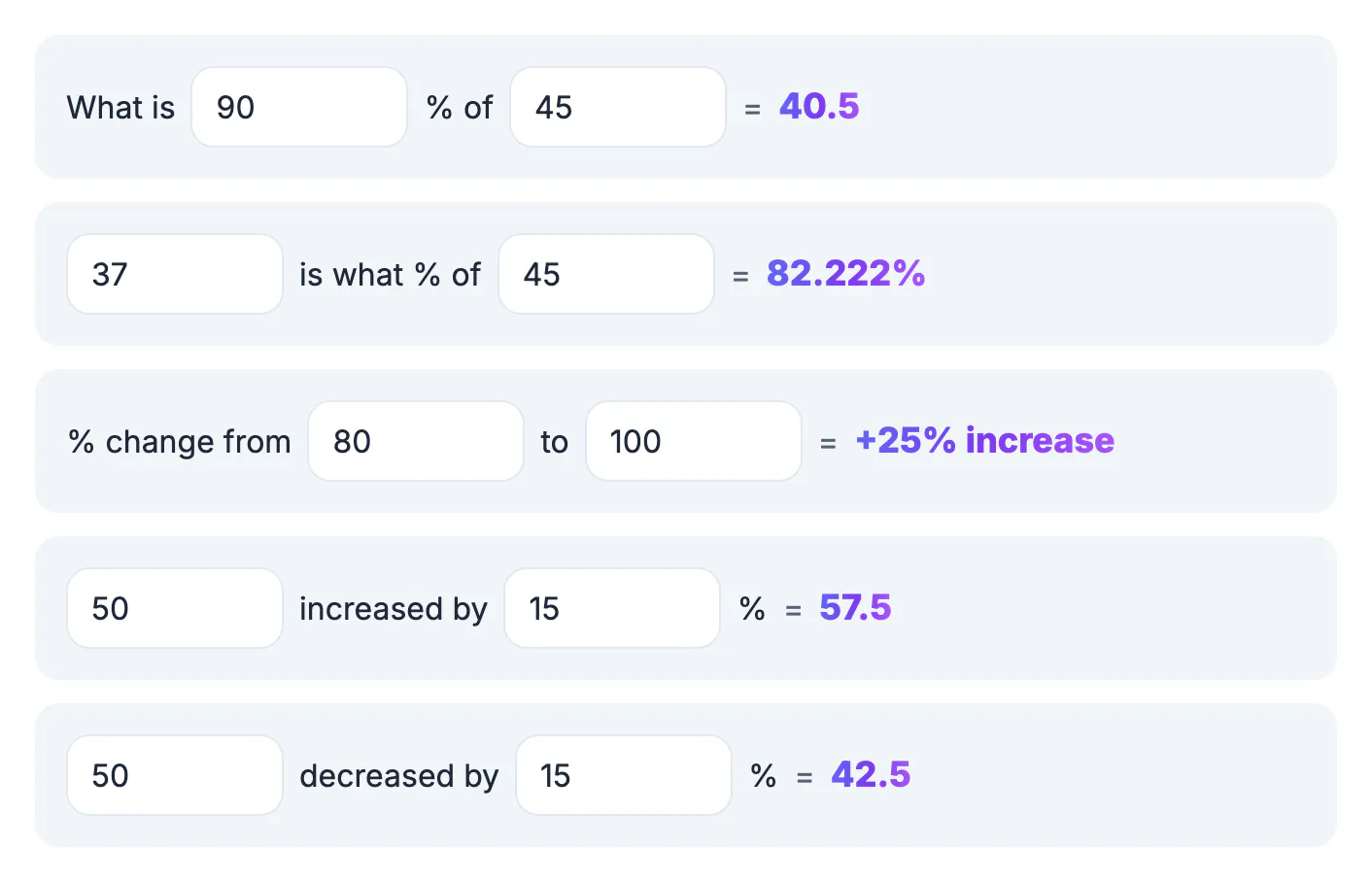
Online gradebooks show a percentage, but they do not always show how it was made: which categories are weighted, whether the lowest quiz is dropped, and how many points are still available. Knowing the formula lets you check a score in seconds, see what you need on the next assignment and plan your effort where it changes the result. It also lets you catch data-entry mistakes early, while they can still be corrected.
The percentage formula
Percentage = points earned ÷ points possible × 100. With 37 of 45: 37 ÷ 45 = 0.82222, times 100 = 82.22 percent. In the calculator, type 37 and 45 into the row that reads "is what % of" and the answer appears as 82.222%.
Round only at the end. If your school rounds to the nearest whole number, 82.22 becomes 82; if it keeps one decimal, it is 82.2. On a common US scale, 80 to 82 is a B−, but scales differ, so read your syllabus.
How many points do you need for a target grade?
Turn the formula around: points needed = target % × points possible. For 90 percent of a 45-point assignment: 0.90 × 45 = 40.5 points. In the calculator use the "What is X % of Y" row: type 90 and 45 and it returns 40.5.
Use this before a test to know your margin. If you scored 37 of 45 on the last one, the 3.5-point gap to 40.5 is the difference between the two grades, and it tells you how many marks a redo or extra-credit item must be worth to matter.
Weighted grades: when categories count differently
Many courses weight categories, for example exams 60 percent and homework 40 percent. Convert each category to a percentage first, multiply by its weight and add the results. With an exam average of 82.22 percent and homework at 95 percent: 0.60 × 82.22 = 49.33, and 0.40 × 95 = 38.00, so the course grade is 87.33 percent. Do not average the two percentages (88.6) unless the weights are equal.
For a semester with several categories, GrabCast's Grade Calculator handles weights, target grades and what-if scores in one place.
Extra credit, dropped scores and rounding
Extra credit adds to earned points without adding to points possible, so 40 of 45 plus 2 extra points is 42 of 45, or 93.33 percent. If a teacher drops the lowest score, remove that assignment from both the earned and the possible totals before dividing. Ask whether your teacher rounds up at a .5 cutoff; some do, and 89.5 becomes an A− in those classes.
Keep a simple running list of earned and possible points for each category. Two totals are all you need, and dividing at the end is always more accurate than averaging percentages. If your school reports a percentage but you need a GPA value, convert the percentage with your school's own scale first; the numbers differ between schools.
Worked examples you can check
Three quick checks confirm your method. A quiz score of 18 out of 20 is 18 ÷ 20 = 0.90, so 90 percent. A homework set with 46 points earned out of 55 is 46 ÷ 55 = 0.8364, or 83.64 percent. If a test has 60 points and you need 75 percent, you need 0.75 × 60 = 45 points. Each uses the same division and the same reverse formula.
When you are close to a cutoff, calculate how many points you can miss on the next assignment and still keep the grade. Subtract your target from the maximum possible and you know your margin; that number is more useful for planning than the percentage itself.
Planning the rest of a term
Once you know your current standing, calculate what you need on remaining work. If exams are 60 percent of the course, you have 70 percent from homework at 40 percent weight, and you want 80 overall, the exam must average (80 − 28) ÷ 0.6 = 86.7 percent. Doing this early shows whether a target is realistic and where to focus revision.
- List each category, its weight and your current average.
- Calculate the contribution of finished work.
- Subtract it from the target, then divide by the weight remaining.
- Re-run after each new score to keep the plan realistic.
The arithmetic builds on calculating a percentage, and working with fractions helps when scores are given as fractions such as 17/20.
When teachers use different scales
Some courses use letter bands, others grade points or curves. Check the syllabus for how percentages map to letters, whether rounding is applied and whether the lowest scores are dropped, since these details change the final result more than a point or two on one quiz.
A short practice set
Try these to check your method. A quiz of 17 out of 20 is 85 percent. A project of 46 out of 50 is 92 percent. An exam of 68 out of 80 is 85 percent. A course with homework at 30 percent weight and an average of 90, and exams at 70 percent weight and an average of 78, ends at 0.3 times 90 plus 0.7 times 78, which is 81.6 percent. Work each one by hand first and then confirm with a calculator.
Keep a simple spreadsheet or notebook page for each course, listing every assignment, the points earned and the points possible. Update it after each return. The running total tells you how much room you have and prevents unpleasant surprises at the end of term. If a score looks wrong, ask the instructor to check it early, while the papers are still fresh in everyone's mind and corrections are easy to make.
Finally, remember that rounding policies vary. Some teachers round at each step and others only at the end, so a result of 89.6 may or may not become an A minus. Read the syllabus, and when in doubt ask directly instead of guessing.
Step-by-step



Common mistakes to avoid
Pro tips
Frequently asked questions
How do I calculate a percentage grade?
Divide the points you earned by the points possible and multiply by 100. 37 out of 45 is 82.22 percent.
How many points do I need for a 90 percent?
Multiply 0.90 by the points possible. On a 45-point assignment you need 40.5 points.
How do I calculate a weighted grade?
Convert each category to a percentage, multiply by its weight as a decimal and add the results.
Does extra credit raise the possible points?
No. It adds to the earned points only, which is why a score can be above 100 percent.
Is the Percentage Calculator free?
Yes. It runs in your browser and needs no account.
A grade percentage is points earned divided by points possible, times 100. Reverse it for the points you need, and use weights when the syllabus has categories. Keep your own points list and you will always know where you stand.
Related guides
Browse more: all calculator guides · Percentage Calculator