Calculate a Percentage: The Formula With Worked Examples
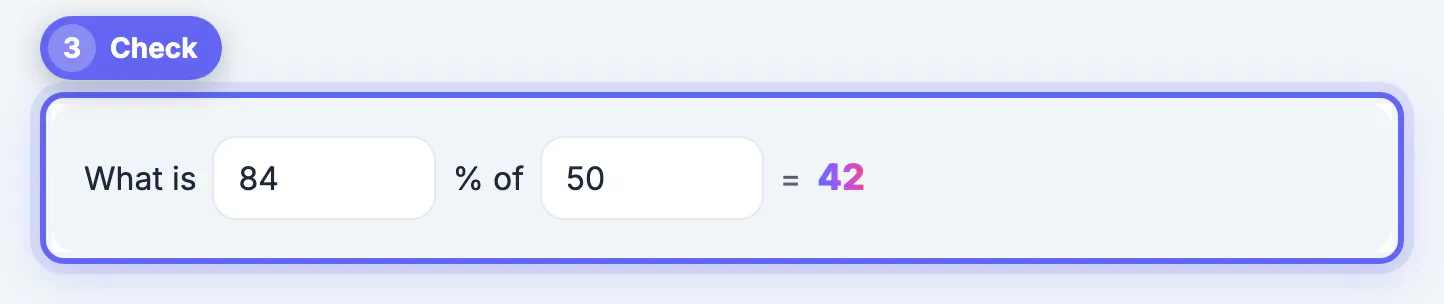
To calculate a percentage, divide the part by the whole and multiply by 100: 42 correct answers out of 50 is 42 divided by 50, which is 0.84, times 100, or 84 percent. Every other percentage question is that same relationship rearranged, whether you need 20 percent of $150, the original price before a sale, or how much your rent went up. This guide shows the three core forms with real numbers, the change formula for raises and price hikes, the reverse trick for finding an original amount, and the traps that fool even careful people, such as stacked discounts and the difference between percent and percentage points.
🧮 Try the Percentage Calculator tool now — freeOpen →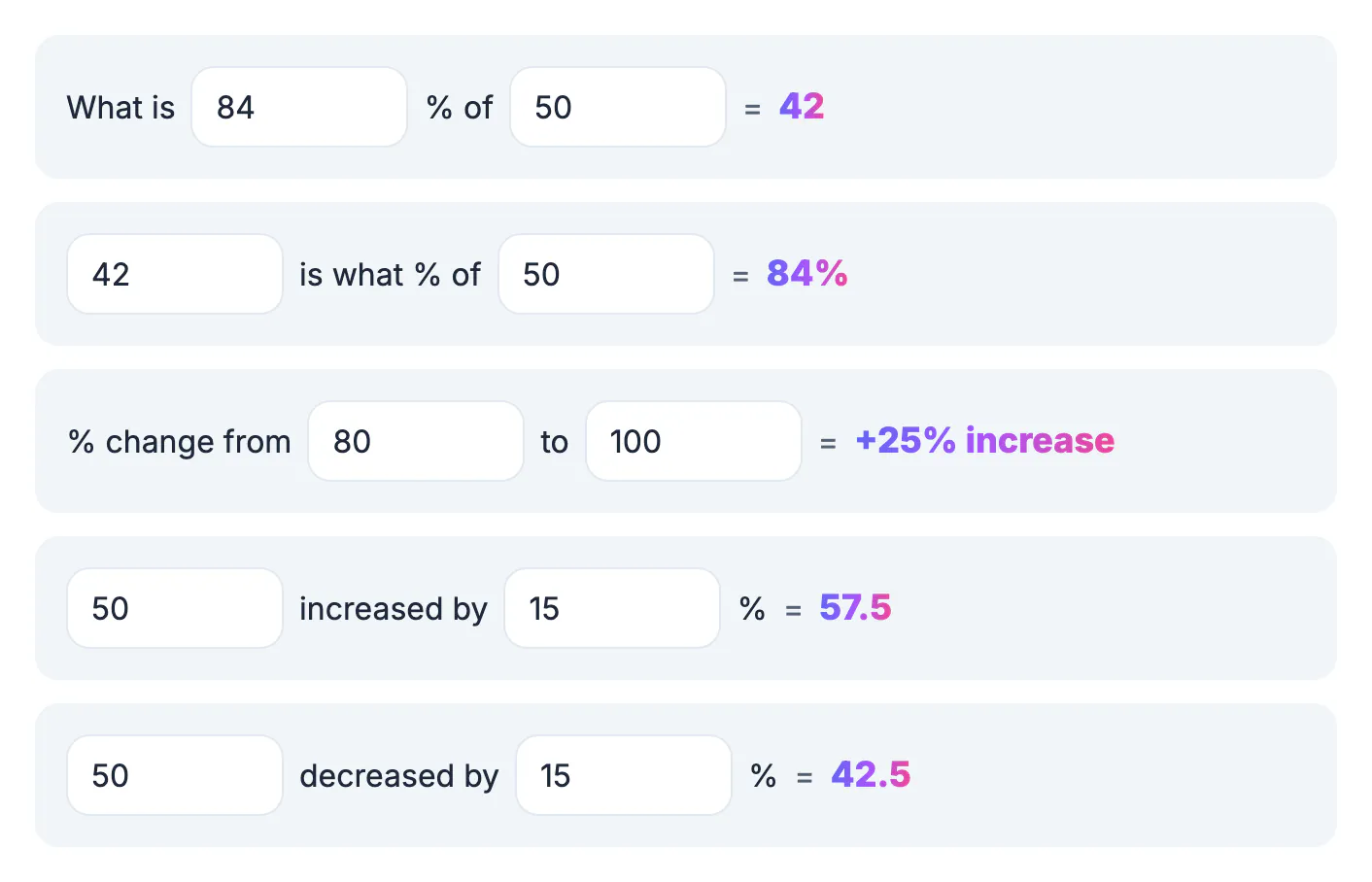
Percent simply means per hundred, so every problem has three pieces: a part, a whole and a rate. If you know any two, the third follows by multiplying or dividing. Learning three separate recipes invites mix-ups under pressure, at a checkout or in a meeting, while one relationship you understand lets you check any answer in your head. GrabCast's Percentage Calculator has five live rows for the common questions, which is handy for speed, but knowing the idea behind them is what stops you from trusting a wrong number on a receipt, a pay stub or a sales report. It also makes spreadsheets easier: in Excel or Google Sheets, a cell containing =B2/C2 formatted as a percentage is the same part-over-whole idea, and the three variations below map directly onto three simple formulas you can reuse for budgets, grade books and sales dashboards.
The three core questions, each with a real example
Write the relationship as part equals rate times whole, with the rate as a decimal (15 percent is 0.15). Then solve for whatever is missing:
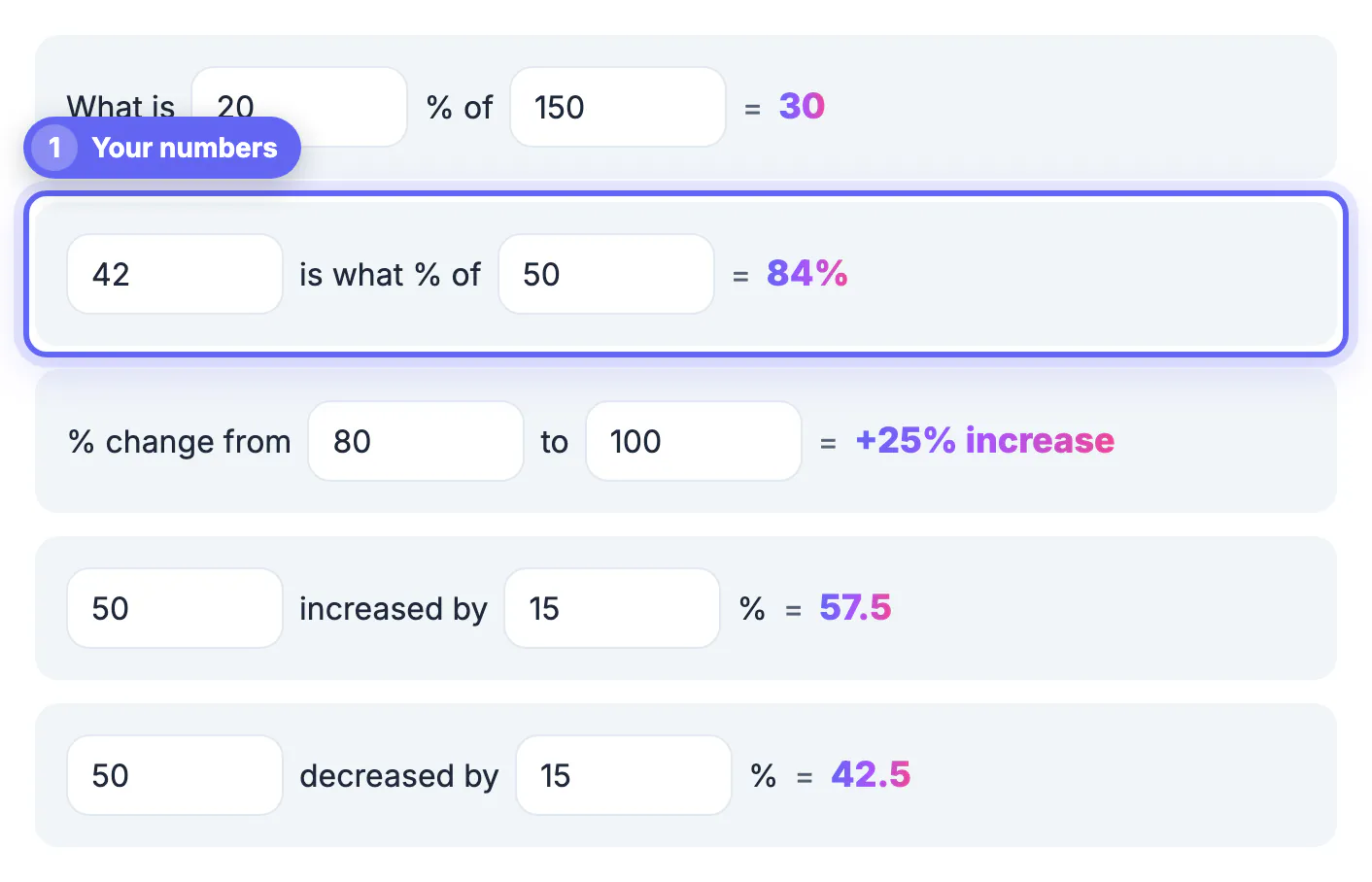
- What is 20 percent of 150? Multiply: 0.20 times 150 equals 30. That is your discount on a $150 jacket.
- 30 is what percent of 120? Divide the part by the whole: 30 divided by 120 is 0.25, so 25 percent. That could be your savings rate on a $120 weekly budget.
- 18 is 15 percent of what? Divide the part by the rate: 18 divided by 0.15 equals 120. Useful when you know the tip you left and the percentage you meant to leave.
- Grade check: 42 out of 50 is 42 divided by 50 times 100, or 84 percent, a B on most US scales.
A fast mental shortcut: 10 percent is the number with the decimal moved one place left. 10 percent of 86 is 8.6, so 5 percent is 4.3 and 15 percent is 12.9. Half of any number is 50 percent, a quarter is 25 percent and a fifth is 20 percent, which covers most sale signs you will ever see without reaching for a phone.
Percent change for raises, prices and growth
When a value moves from an old number to a new one, subtract, divide by the old number and multiply by 100. A raise from $52,000 to $55,120 is a change of 3,120, and 3,120 divided by 52,000 is 0.06, so a 6 percent raise.
The direction matters because the base changes. Going from 80 to 100 is a 25 percent increase, but going from 100 back to 80 is a 20 percent decrease. That is why a stock that falls 50 percent must then rise 100 percent just to get back to even, and why a store can mark something up 25 percent and later advertise 20 percent off without losing a cent.
To apply a change, multiply by one plus or minus the rate. A $50 item after a 15 percent increase is 50 times 1.15, or $57.50; after a 15 percent decrease it is 50 times 0.85, or $42.50.
Work backward to find the original number
Many everyday questions give you the result and hide the starting point. The fix is to divide instead of subtracting:
- A sale price of $60 after 25 percent off: the $60 is 75 percent of the original, so 60 divided by 0.75 equals $80. Subtracting 25 percent of 60 would wrongly give $75.
- A take-home bonus of $3,900 after 22 percent federal withholding: 3,900 divided by 0.78 is $5,000 gross.
- A population of 10,500 after 5 percent growth: 10,500 divided by 1.05 gives 10,000 the year before.
- A receipt total that already includes a sales levy works the same way, divided by one plus the rate.
Whenever a question says after, including or already, reach for division by the multiplier rather than taking a percentage of the final number.
Traps that make a percentage look wrong
These four catch people most often:
- Stacked discounts do not add. 20 percent off, then an extra 10 percent off, is 0.80 times 0.90, or 0.72 of the price, a 28 percent total discount rather than 30.
- Percent versus percentage points. A mortgage rate moving from 4 percent to 5 percent rose one point, which is a 25 percent increase in the rate itself.
- The wrong base. A 50 percent margin and a 50 percent markup are different: a $100 cost marked up 50 percent sells for $150, a 33 percent margin.
- Tiny bases exaggerate. Sales going from 2 units to 6 is a 200 percent jump, which sounds dramatic and means very little.
A quick sanity check catches most slips: a part smaller than the whole must be under 100 percent, and a decrease can never exceed 100 percent. When a headline or a colleague quotes a dramatic figure, ask for the two raw numbers behind it; the story usually changes once you see the base.
Stacked percentages are a classic trap, as this explanation of why 40% plus 15% is not 55% shows with real numbers.
Step-by-step

Common mistakes to avoid
Pro tips
Frequently asked questions
What is the formula to calculate a percentage?
Part divided by whole, times 100. For 45 out of 60, that is 45 divided by 60, which is 0.75, times 100, or 75 percent. The same formula works for test scores, survey results, budget shares and completion rates.
How do I work out a percentage of an amount?
Convert the percentage to a decimal and multiply. 35 percent of $240 is 0.35 times 240, which equals $84. In a spreadsheet the same thing is =240*35% or =240*0.35, and both return 84.
How do I calculate a percentage increase?
Subtract the old value from the new, divide by the old and multiply by 100. From $40 to $46 is 6 divided by 40, a 15 percent increase.
Why is going up 50 percent and down 50 percent not even?
Because the second change applies to a bigger base. 100 up 50 percent is 150, and 150 down 50 percent is 75, a net loss of 25 percent.
How do I find the original price before a discount?
Divide the sale price by one minus the discount rate. A $68 item at 15 percent off came from 68 divided by 0.85, which is $80.
Every percentage problem is part equals rate times whole, rearranged. Multiply to find a portion, divide the part by the whole to find the rate, divide by the multiplier to recover an original, and base any change on the starting value. Watch the classic traps: stacked discounts multiply rather than add, percentage points are not percent, and markup is not margin. Use the Percentage Calculator for speed, and a ten-percent mental check to catch answers that cannot be right.
Related guides
Browse more: all calculator guides · the Percentage Calculator tool