How to Convert Inches to cm (Formula + Quick Trick)
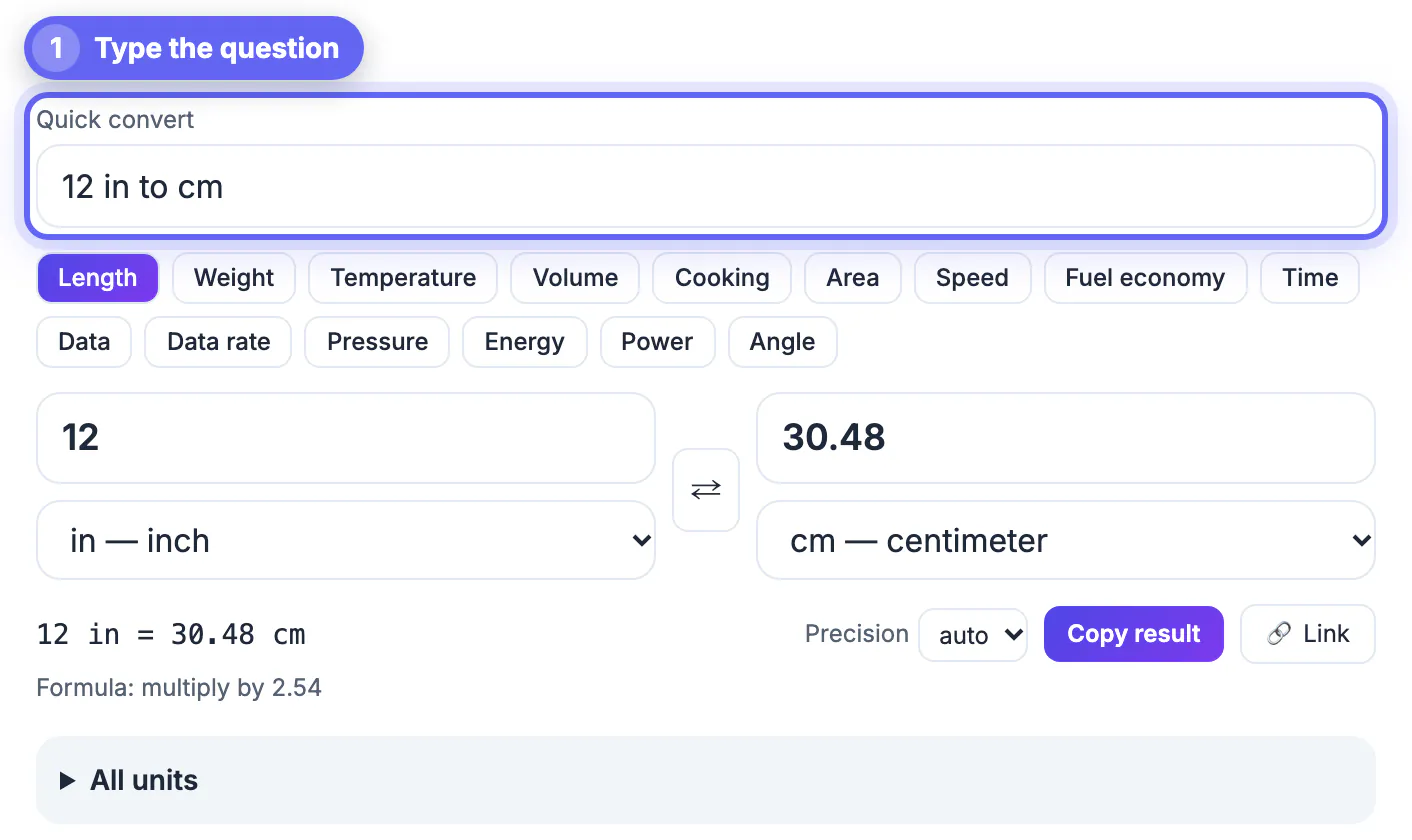
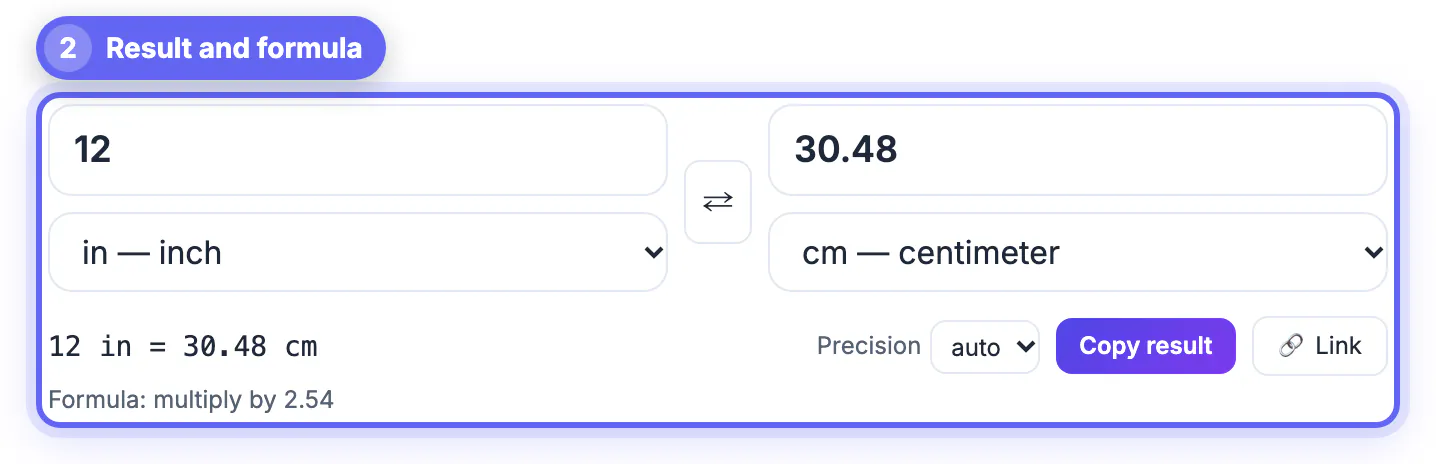
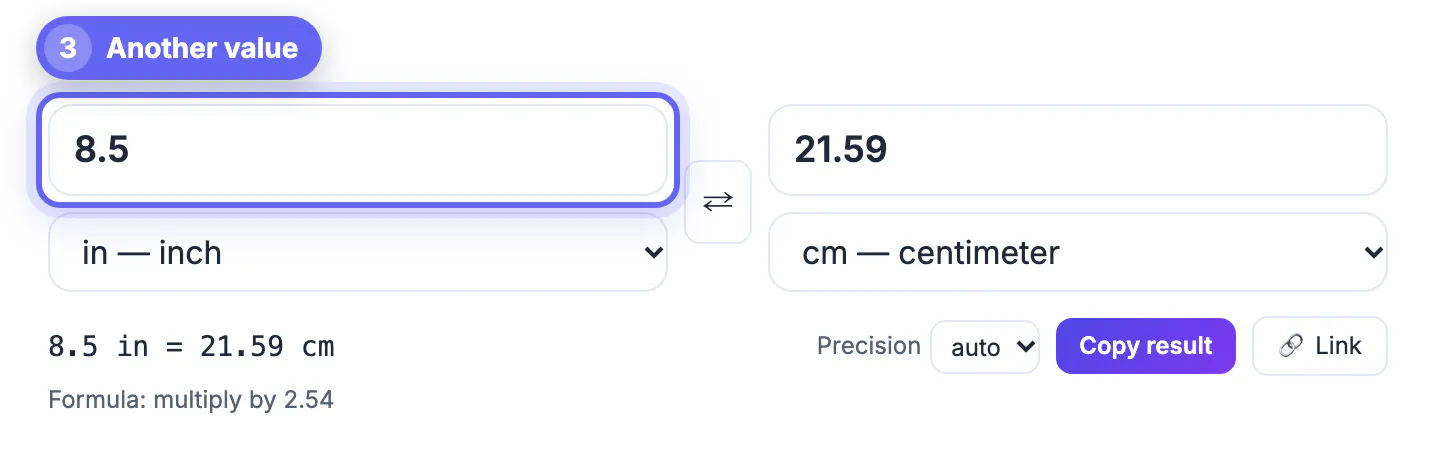
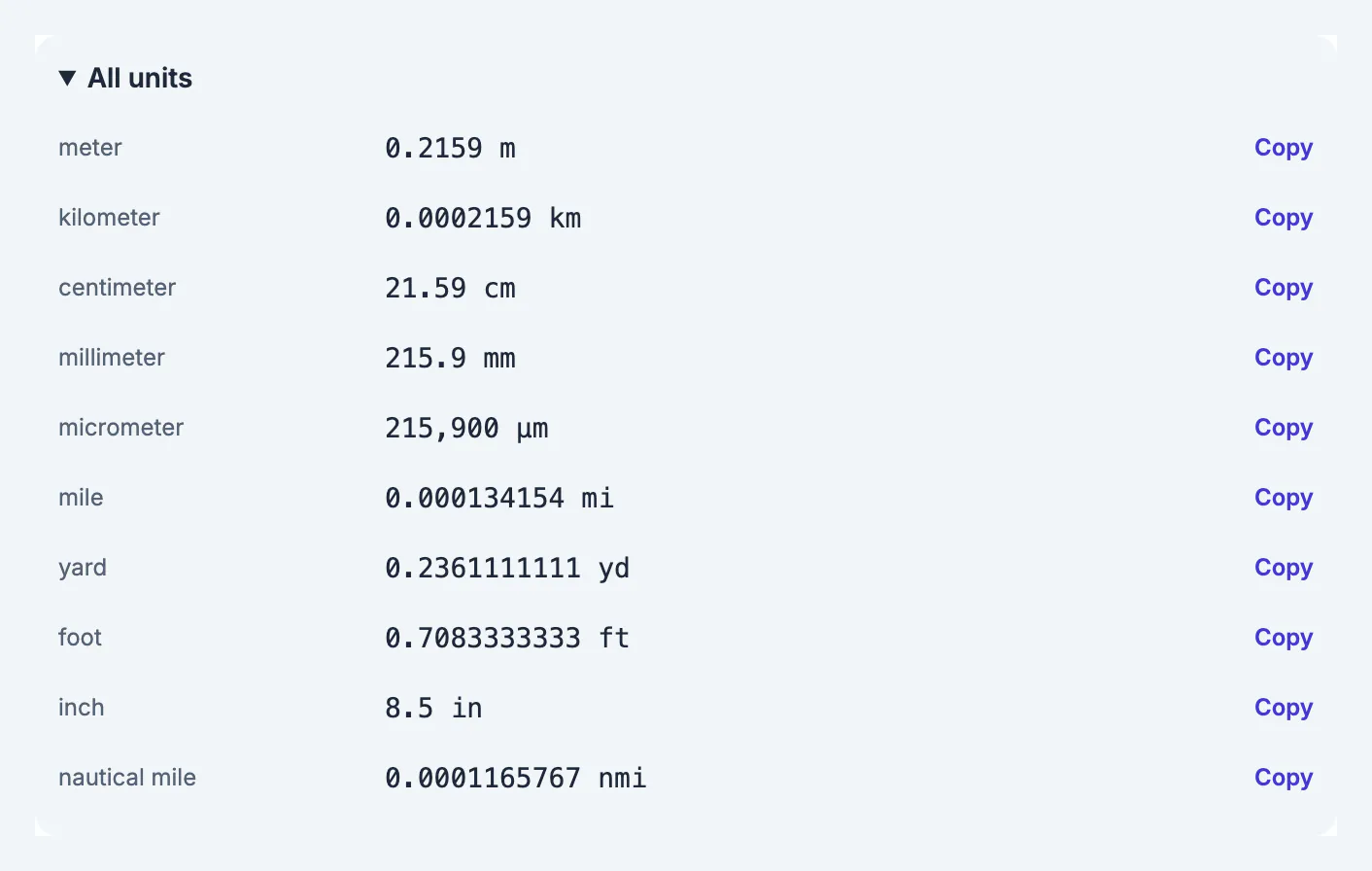
To convert inches to centimeters, multiply the inches by 2.54. Twelve inches is 12 × 2.54 = 30.48 cm, and a US Letter sheet, 8.5 inches wide, is 21.59 cm. The factor is exact by definition, so the only judgment call is how many decimals to keep. This guide covers the formula, how to handle fractions such as 3/8 inch, the sizes people convert most (paper, TVs, tape measures, clothing) and the steps in GrabCast's free Unit Converter, illustrated with screenshots of the real tool.
📐 Try Unit Converter now — freeOpen →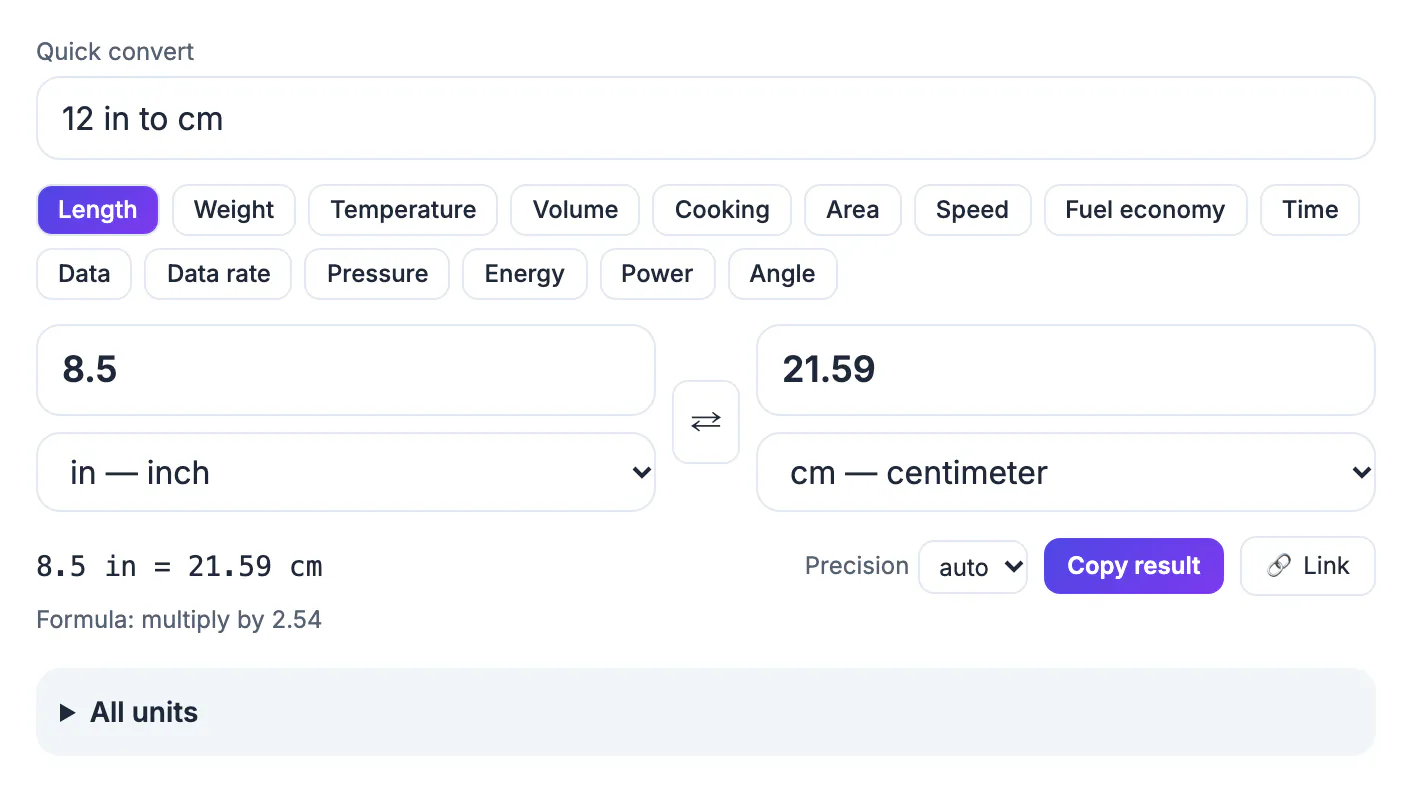
Inches arrive as fractions, mixed numbers and decimals, often on the same tape measure, while centimeters are always decimal. That mismatch is what makes a conversion feel harder than it is. A plan drawn in inches, a product listed in inches on a US site or a TV advertised by its diagonal all end up on a metric ruler at some point. Getting the multiplication right once and knowing how to turn a fraction into a decimal first removes almost every mistake.
The inches to cm formula
Use centimeters = inches × 2.54. To go the other way, divide by 2.54. The factor is not a rounded figure: one inch is defined as exactly 25.4 millimeters.
Example: a 12 in ruler is 12 × 2.54 = 30.48 cm. A 6 in phone screen diagonal is 15.24 cm. An 8.5 in wide page is 21.59 cm. When you have many values, multiply the total once rather than each piece.
Fractions and mixed numbers
Turn a fraction into a decimal before you multiply. Divide the top by the bottom: 3/8 is 0.375, 1/4 is 0.25, 5/16 is 0.3125. A mixed number such as 5 3/8 in becomes 5.375 in, and 5.375 × 2.54 = 13.6525 cm, which you would round to 13.65 cm or 13.7 cm depending on the job.
Common fractions in centimeters: 1/8 in = 0.32 cm; 1/4 in = 0.64 cm; 3/8 in = 0.95 cm; 1/2 in = 1.27 cm; 3/4 in = 1.91 cm.
Sizes people convert most
Values computed with the exact factor:
- 1 in = 2.54 cm
- 6 in = 15.24 cm
- 8.5 in = 21.59 cm (US Letter width)
- 11 in = 27.94 cm (US Letter height)
- 24 in = 60.96 cm
- 32 in = 81.28 cm
- 55 in = 139.7 cm (a 55-inch TV diagonal)
A TV size is a diagonal, so a 55 in screen is 139.7 cm corner to corner, not its width. Its actual width, at a 16:9 shape, is closer to 122 cm. Check the specification sheet if you are measuring a wall unit or a stand.
Measuring in inches, cutting in centimeters
If your drawing is in inches and your ruler is metric, mark the converted value to one decimal (a tenth of a centimeter is one millimeter, the smallest mark). Rounding to the nearest whole centimeter can be off by up to 5 mm, which is far more than a joint can forgive.
For clothing, charts printed in inches usually list body measurements, not garment measurements. If a waist is 32 in, that is 81.28 cm; a size chart in centimeters will usually round to 81 or 82.
A worked example from start to finish
Say a plan calls for a 3 1/2 in wide board and your saw guide is metric. Convert the fraction: 1/2 is 0.5, so the width is 3.5 in. Multiply: 3.5 × 2.54 = 8.89 cm. That is 88.9 mm, so on a metric ruler you mark 88.9 mm, which sits between the 88 and 89 lines. If two boards are needed side by side, convert the combined width (7 in = 17.78 cm) rather than doubling a rounded 8.9, which would give 17.8 cm and a 0.2 mm gap.
The same habit works for anything you will add up: convert once, at the end, from the exact inches figure.
Picking a sensible number of decimals
The right amount of precision depends on what you are doing. A person's height or a picture frame is fine to the nearest half centimeter, furniture and shelving to the nearest millimeter, and machine parts sometimes need more digits than a tape measure can show. Report as many decimals as the measuring tool can actually resolve and no more, because extra digits give a false impression of accuracy.
When you pass a converted measurement to someone else, say which unit it is in and how it was rounded. A note such as "about 61 cm, rounded from 24 inches" prevents the common mix-up where one person cuts to the rounded number while another expects the original. Whenever you can, keep the original inch value next to the centimeter one in your notes, so that anyone reviewing the work can retrace the conversion and spot a slip quickly.
Checking sizes when you shop or travel
Inch measurements appear on US clothing, tools, tires, screens and furniture. Converting them avoids returns and surprises at the airport.
- TVs and monitors: a 27 in screen measures about 68.6 cm diagonally.
- Luggage: a 22 in carry-on is about 55.9 cm, which may exceed a 55 cm limit.
- Rings and bracelets: confirm whether the size is a diameter or circumference.
- Pipe and fasteners: a 1/2 in bolt is 12.7 mm, and metric versions are not always interchangeable.
To go the other way, converting cm to inches has the reverse formula, and converting mm to inches is helpful for small parts. For page sizes, A4 vs US Letter paper sizes shows how the two systems affect printing.
A quick sanity check
One inch is a little more than 2.5 cm, so any converted value should be about two and a half times the inch figure. If your answer is nearer to 25 or 0.25 times, you have misplaced a decimal point. Checking the order of magnitude takes a second and catches the most common error.
A short practice set
Try these to check your method. A 17 in laptop is 43.18 cm wide. A 3 in screw is 7.62 cm. A 48 in table is 121.92 cm. Each comes from multiplying by 2.54, and the final digits rarely matter outside precision work. If you can estimate each one in your head first and then confirm with a calculator, you will quickly gain a feel for the numbers, which helps when reading product pages, checking a quote for furniture or curtains, or following an American tutorial with a metric tape measure in your hand.
Keep a small card in your toolbox with the handful of conversions you use most, such as 1 in, 6 in, 12 in and 36 in. Having them at hand speeds up marking and cutting and reduces mistakes caused by doing arithmetic while holding a saw or a pencil. When precision matters, measure twice, convert once and write the result in both systems on the plan.
Step-by-step
Common mistakes to avoid
Pro tips
Frequently asked questions
How many cm are in an inch?
There are exactly 2.54 centimeters in one inch.
How do I convert feet and inches to cm?
Turn the feet into inches (multiply by 12), add the inches, then multiply the total by 2.54. Five feet four inches is 64 in, which is 162.56 cm.
What is 12 inches in cm?
12 inches is 30.48 cm, the length of a standard ruler.
How wide is US Letter in centimeters?
Letter paper is 8.5 × 11 inches, which is 21.59 × 27.94 cm.
Does the converter handle fractions?
Type the decimal form (0.375 for 3/8). The converter works with decimal numbers and shows the factor it used.
Inches to centimeters is a single multiplication by 2.54. Convert fractions to decimals first, keep the precision your project needs and let the converter show the factor so you can trust the result.
Related guides
Browse more: all calculator guides · Unit Converter