Count Words in an Essay: What Graders Actually Count
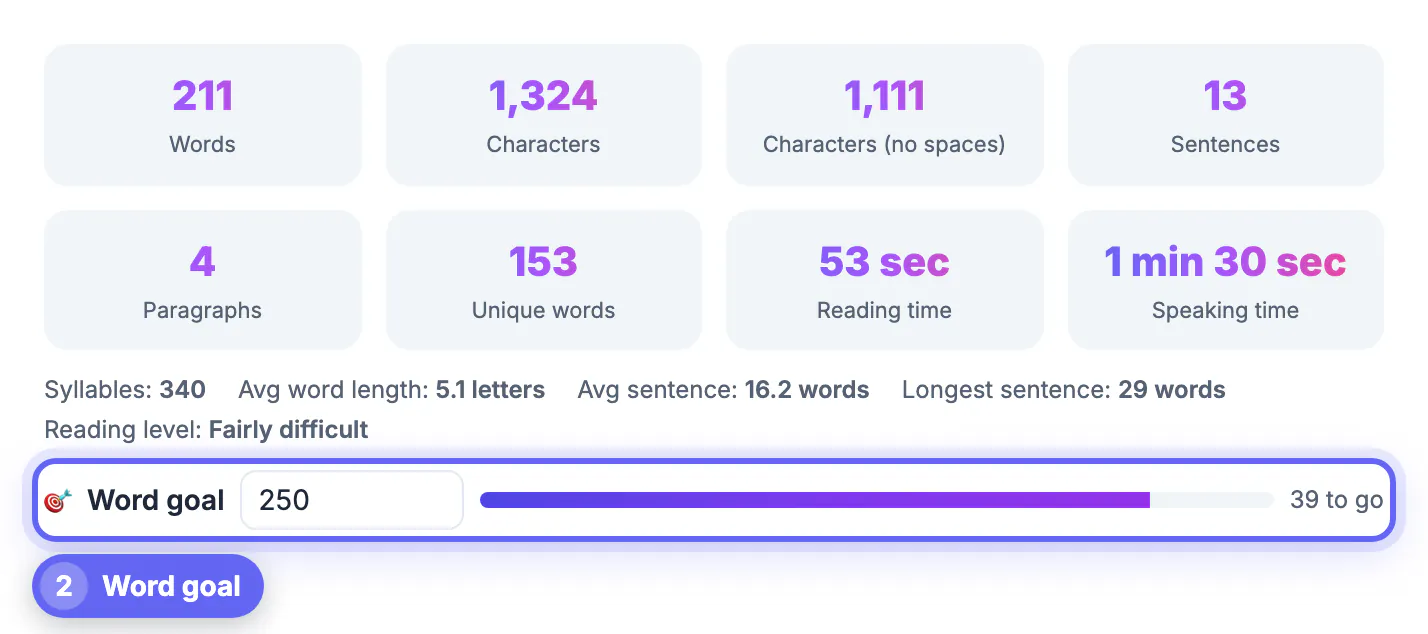
To count words in an essay, paste only the part that is graded, usually the body without the title, name block and reference list, into a counter and compare the total with the limit. GrabCast's free Word Counter updates as you type, and a Word goal bar shows how close you are to the target. The number itself is the easy part. The harder parts are knowing what your instructor or application portal actually includes, why two tools can disagree by a handful, how to plan the length of each section before you draft, and how to cut 80 over the limit or add 150 under it without making the essay worse. This guide covers all four with real limits, such as the Common App's 650 and the University of California's 350 per question, and concrete editing moves. The counter runs in your browser, so your draft is not uploaded.
🔢 Try the Word Counter tool now — freeOpen →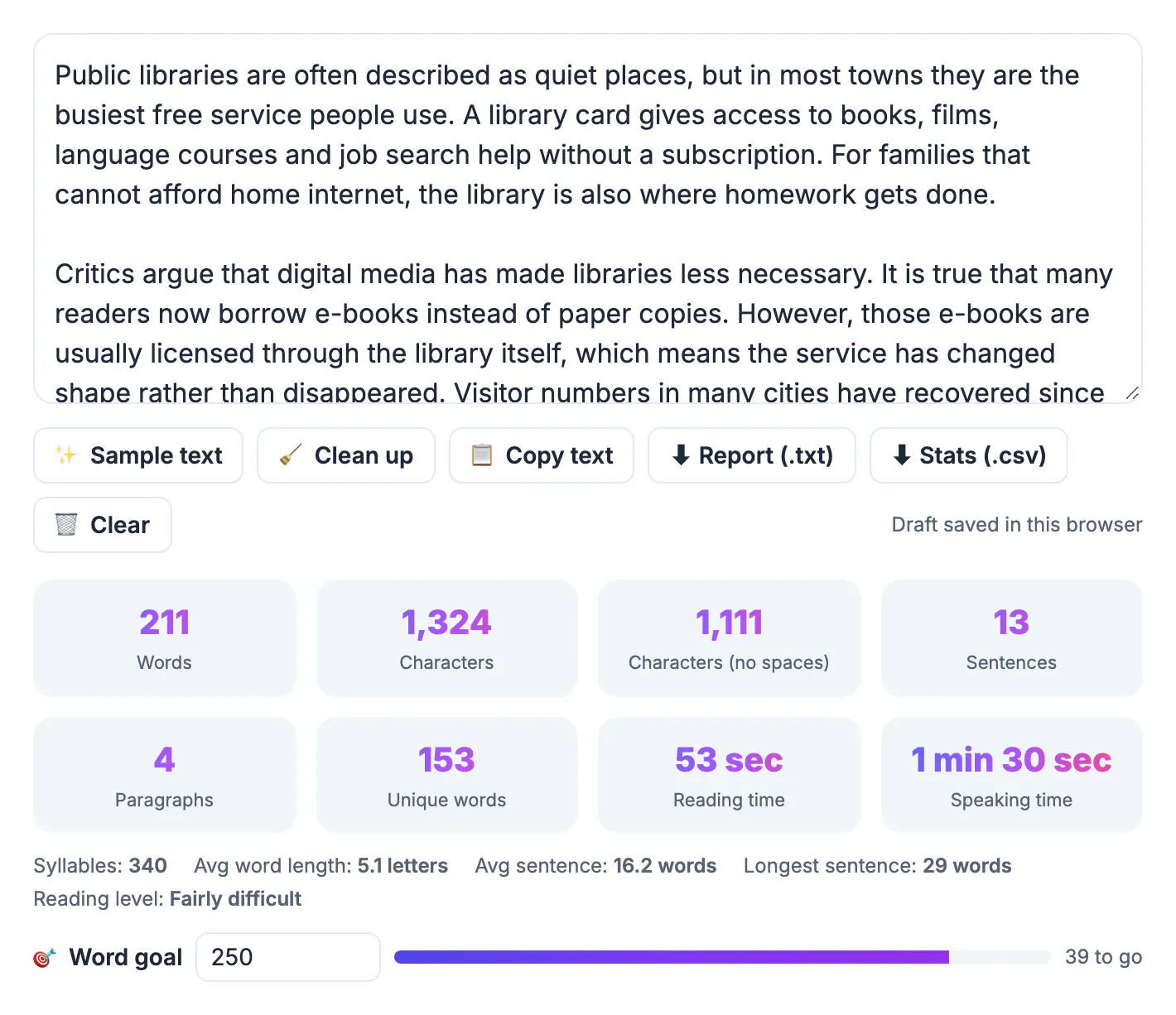
Limits are rules, not suggestions, in many settings. The Common App personal essay runs from 250 to 650, University of California personal insight questions allow 350 each, and many scholarship and supplement prompts sit between 150 and 500. Online portals often cut you off at the cap or refuse to submit, so a draft that is 20 over has to be trimmed anyway, usually in a hurry. In class, some instructors deduct points or stop reading past the limit, and a paper far short of the minimum suggests an underdeveloped argument. Some teachers allow about 10 percent either way; others treat the limit as a hard ceiling, so check before assuming any leeway. Knowing your precise total early turns editing into a planned pass rather than a panicked deletion of your best sentence at midnight, and checking after each major revision shows which section is growing out of proportion while there is still time to rebalance it.
Decide what your essay's limit includes
Before you trust any total, check the assignment sheet, the rubric or the style guide your class follows. Common conventions, which your instructor can override:
- Usually included: the body paragraphs, including quotations woven into your sentences and in-text citations such as (Smith, 2021).
- Often excluded: the title, the name and date block, section headings, the reference list or works cited page.
- Varies: footnotes, block quotations, captions, tables and appendices; ask when the guidelines are silent.
- Application portals: whatever sits inside the text box is what they tally, so a title typed there uses part of the limit.
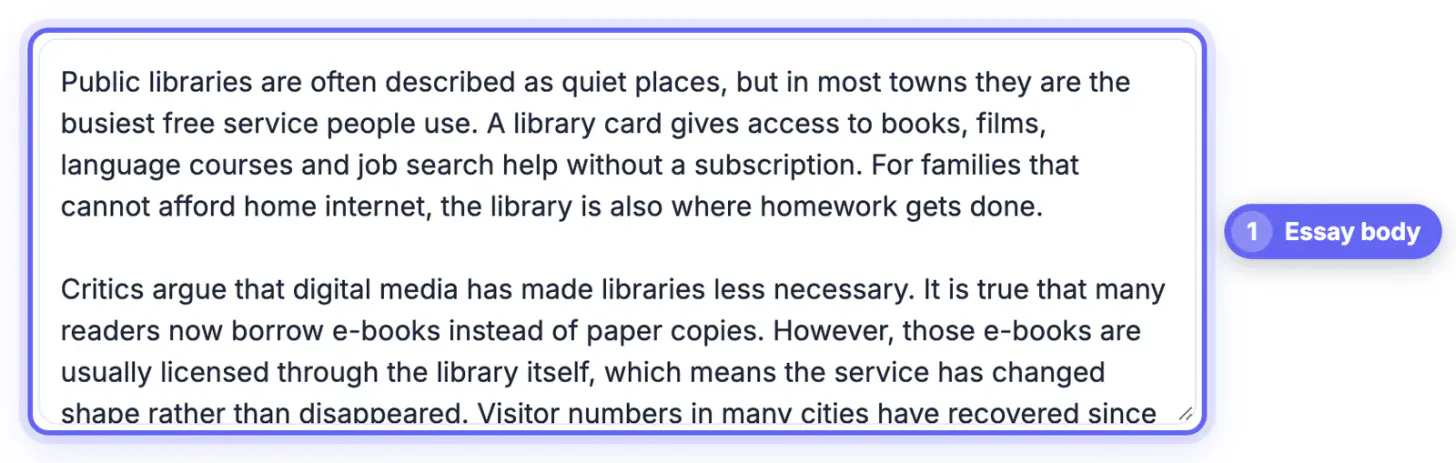
Paste just the graded portion, or paste everything and subtract the extras, so the figure on screen matches the one the grader sees. If quotations make up a large share of a research paper, a one-line email asking whether they count is far better than guessing.
Budget the length before you draft
Planning each section's share of the limit prevents the common problem of a long introduction and a rushed ending. Rough budgets that work for many assignments:
- 650-word personal statement: an opening scene of about 100, two developed moments of about 200 each, and a reflective close of about 150.
- 350-word short answer: one sentence that answers the prompt directly, one specific example of about 200, and a closing link to what you will do next.
- 2,000-word argumentative essay: an introduction and conclusion of about 200 each, three body sections of about 500, and 100 in reserve.
- Five-paragraph class essay of 800: about 120 for the introduction and conclusion and roughly 190 for each body paragraph.
Paste each section on its own to see which one has outgrown its share. Set the Word goal to the full limit so the progress bar shows how much room is left as you work.
Why tools disagree when you count words in an essay
GrabCast's tool treats any group of characters separated by spaces or dashes that contains a letter or number as one word, so well-known and don't count once and a stray symbol does not count at all. Google Docs, Microsoft Word and portal boxes use their own rules for hyphens, slashes, numbers and symbols, so a 650-word draft can read 646 in one place and 652 in another.
- Aim a few under a hard cap to absorb those differences.
- When a portal enforces the limit, its own box is the final authority; paste your draft there a day before the deadline.
- Word and Google Docs show a smaller figure when part of the document is selected, so click once in the text before reading the total.
- Footnotes and text boxes may or may not be included in Word, depending on a checkbox in its count dialog.
Some forms limit characters rather than words; the tool shows characters with and without spaces for that case.
Cutting when you are over, expanding when you are under
Trim wording before ideas. Most drafts carry 10 to 15 percent of phrases that add length and no meaning.
- Delete throat-clearing openers such as In this essay I will discuss.
- Swap phrases for single terms: due to the fact that becomes because; in order to becomes to.
- Remove stacked qualifiers such as very, really, quite and somewhat, and check the Keywords tab for a term you repeat a dozen times.
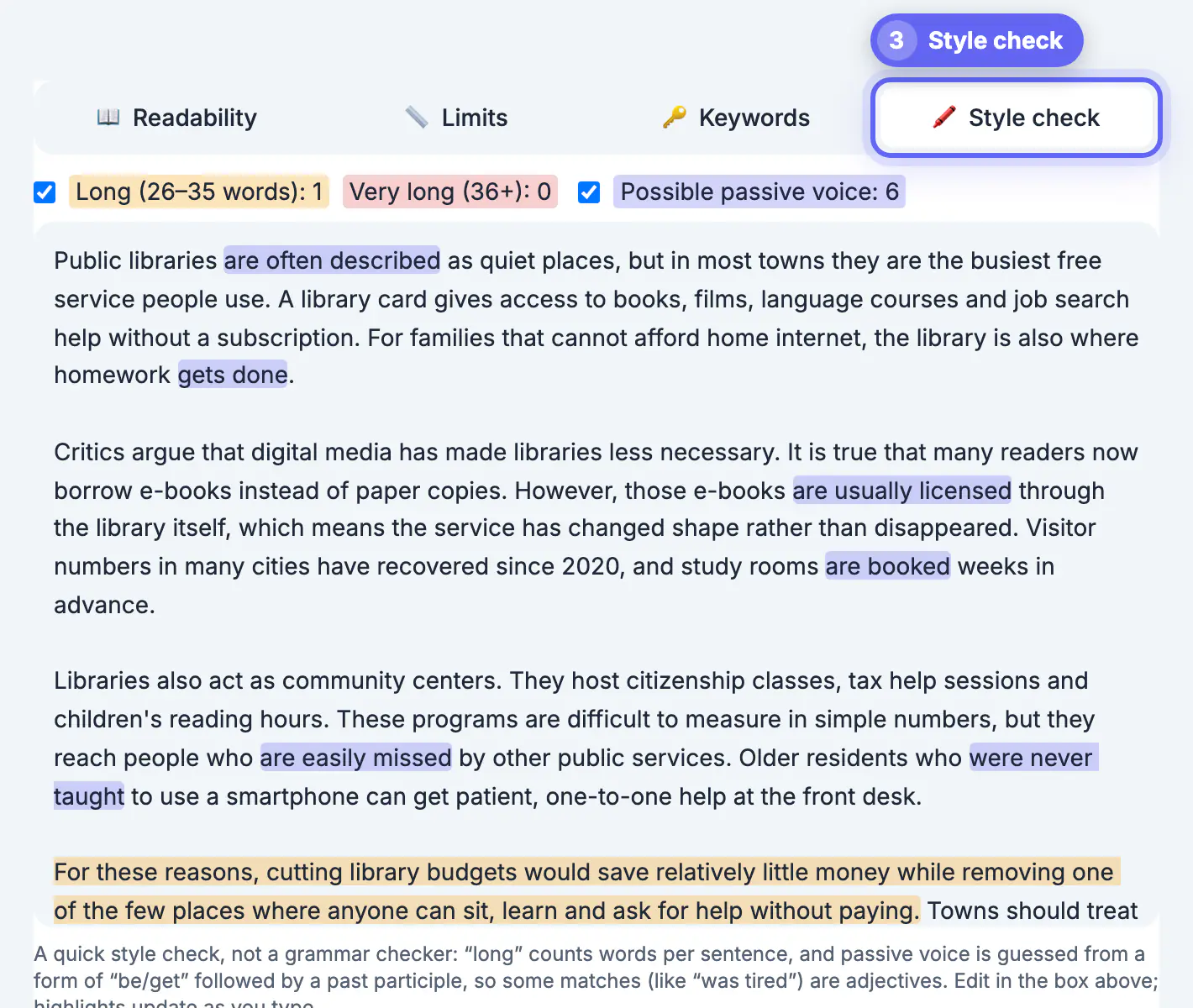
- Open Style check to find sentences over 25 words; splitting or tightening them often saves space and improves the Flesch–Kincaid grade shown in Readability.
- If you are still far over, remove the weakest example entirely rather than shaving every paragraph thin.
When you are short, add substance, not padding: a specific example, a counterargument with your answer, or a clearer link between evidence and claim. For a personal statement, one sensory detail and one sentence of reflection often add 40 to 60 of the most valuable lines in the piece. Reading time at 238 per minute and speaking time at 140 help too; a 650-length piece takes under 3 minutes to read and about 4 and a half minutes aloud.
If you must trim, a summarizing guide shows how to boil text down, and the Text Diff Checker compares drafts before and after.
Step-by-step
Common mistakes to avoid
Pro tips
Frequently asked questions
Does the title count toward an essay's limit
Usually not in class assignments, where instructors typically measure the body only, but check the assignment sheet or rubric first. In application portals, anything typed into the essay box is included, so a title placed there uses part of the limit.
Are citations and references included
In-text citations inside sentences usually are, while the reference list or works cited page usually is not. Footnotes and block quotations vary by instructor and department, so ask if the guidelines do not say.
How strict is an essay word limit
It depends on who sets it. Application portals such as the Common App stop you at the cap. Some instructors accept about 10 percent over or under; others deduct points for any overage. When in doubt, treat the number as a ceiling.
How long is a 650-word essay
Roughly one and a quarter pages single spaced or two and a half pages double spaced in a standard 12-point font. At 238 per minute it takes under 3 minutes to read, and about 4 and a half minutes to say aloud at 140 per minute.
Is my essay stored or uploaded
It is not uploaded; the counter runs in your browser. It saves the draft in that browser's local storage so a refresh does not lose it, so press Clear when you finish on a shared school or library computer.
Include only what the grader includes, plan each section's share of the limit before you write, and stay a few under any hard cap because tools disagree by a handful. Cut wording before ideas, add examples rather than filler, and treat the portal's own box as the final check before you submit.
Related guides
Browse more: all text and developer guides · the Word Counter tool