How to Convert mm to Inches (Formula + Quick Trick)
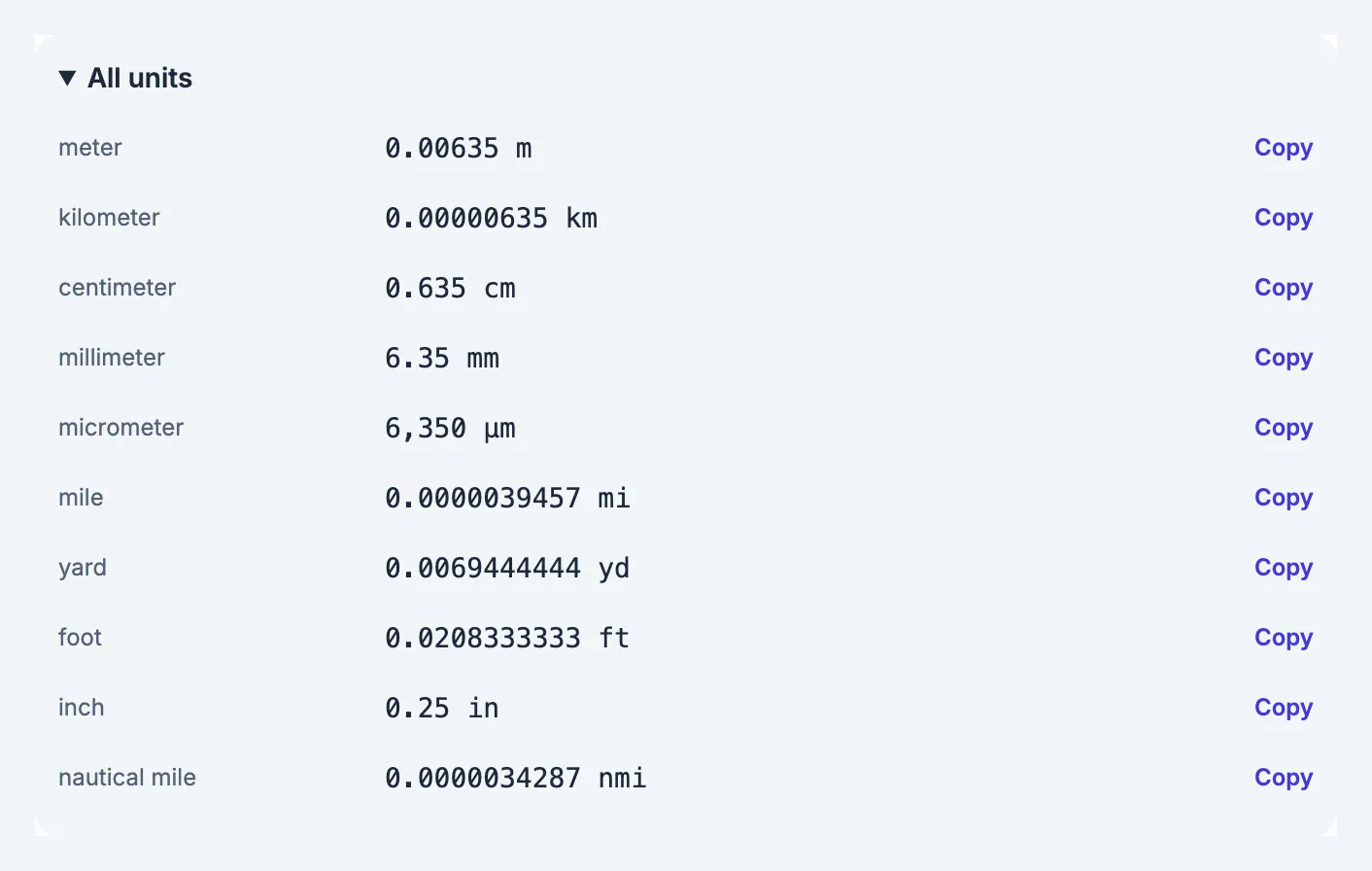
To convert millimeters to inches, divide the millimeters by 25.4. A 25 mm bolt is 25 ÷ 25.4 = 0.984 inches, and 6.35 mm is exactly 0.25 in, a quarter inch. Millimeters and inches meet in workshops, on drill bits and fasteners, in camera lens specs and in phone or laptop dimensions, where the precision matters more than for a room measurement. This guide shows the formula, how to turn a decimal result into the nearest fraction a tape measure or drill index uses, the common sizes and the steps in GrabCast's free Unit Converter, with screenshots.
📏 Try Unit Converter now — freeOpen →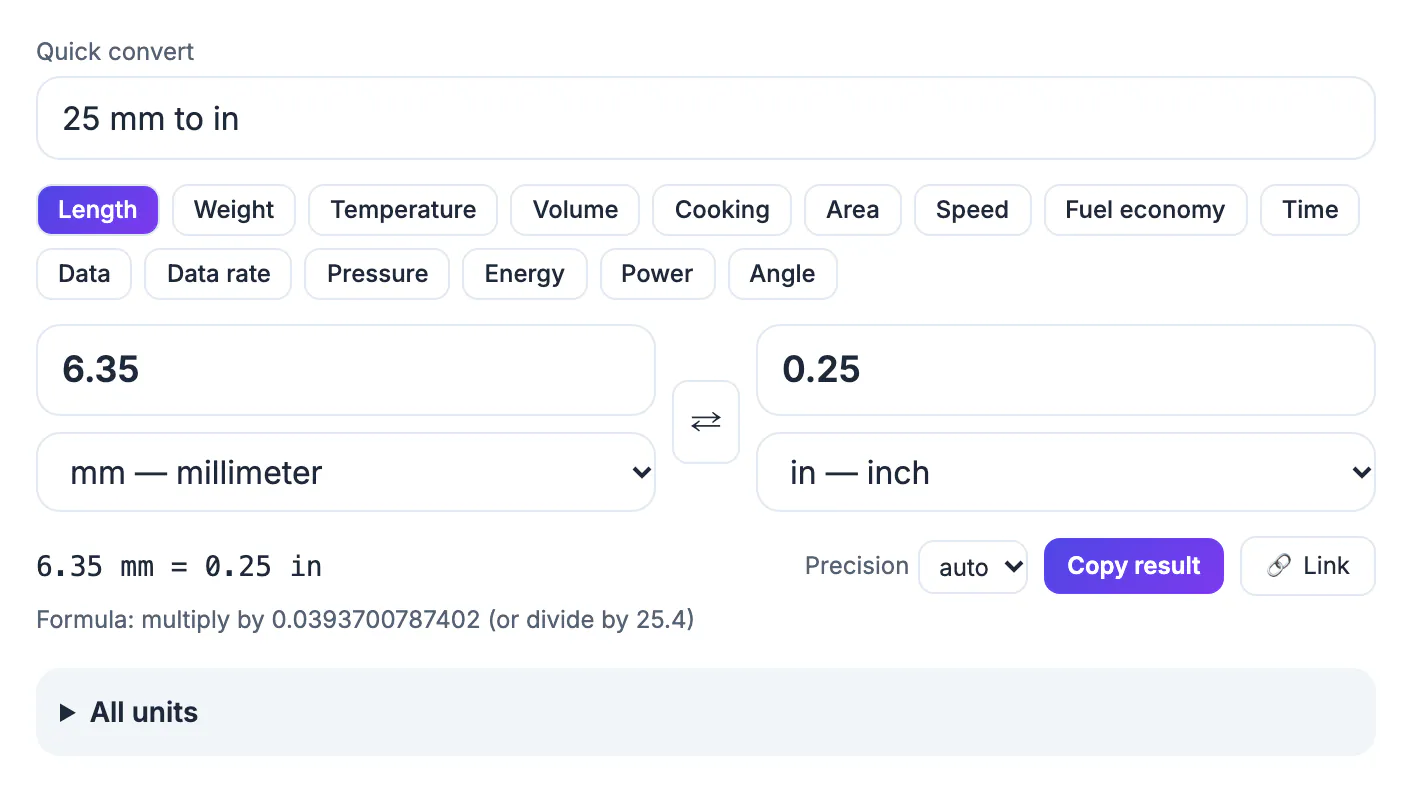
With millimeters you are usually working at a precision where a tenth of a millimeter counts: a drill bit that is 0.1 mm too big can loosen a fit, and a phone case that is 0.5 mm too tight will not close. At the same time the inch side of the job is often written as a fraction (5/16 in) rather than a decimal. So the useful conversion is really two steps: millimeters to a decimal inch, then the decimal to the nearest fraction that exists on a real tool.
The mm to inches formula
Use inches = millimeters ÷ 25.4, or mm × 0.0393701. The factor is exact because one inch is defined as 25.4 mm. To go back, mm = inches × 25.4.
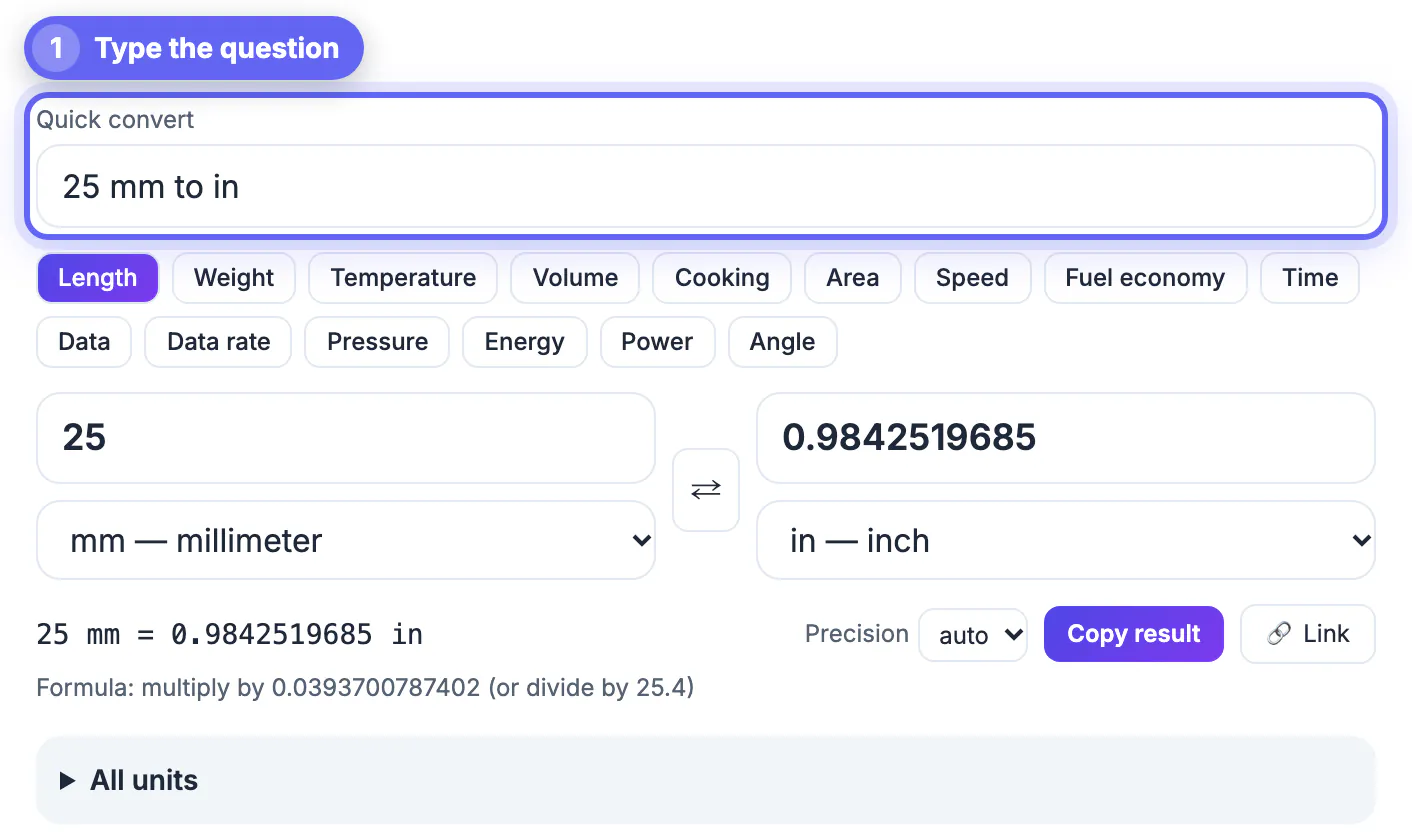
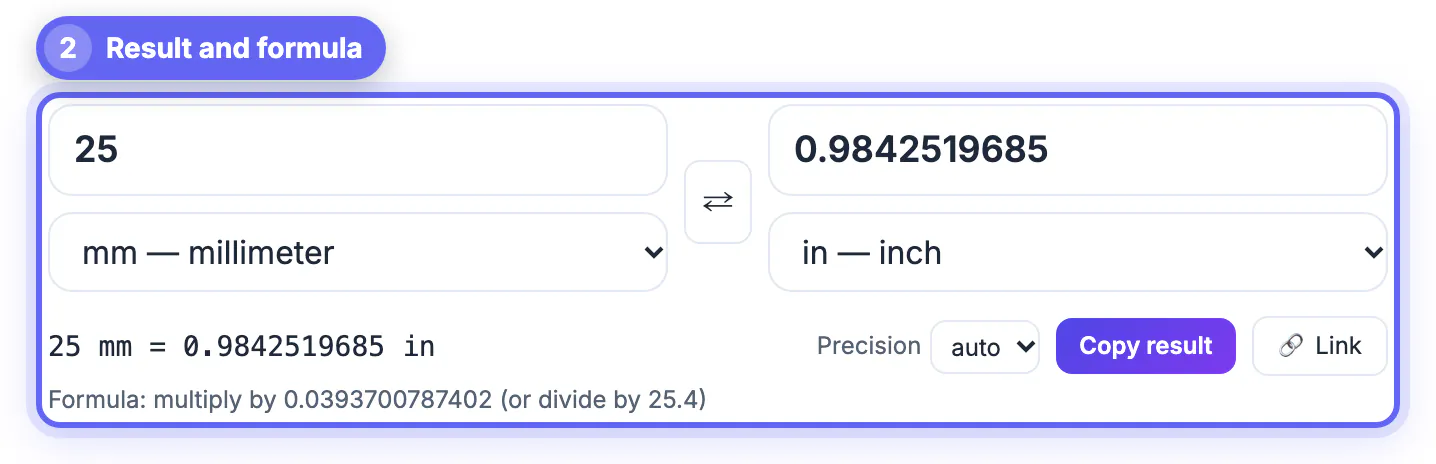
Example: 25 mm ÷ 25.4 = 0.98425 in, which the converter shows as 0.9842519685. For workshop use, three decimals (0.984) are plenty. For a spec sheet, keep four.
From a decimal inch to a fraction
Tool sizes are usually in sixteenths, thirty-seconds or sixty-fourths of an inch. Multiply the decimal inches by the denominator you want and round: 0.984 × 16 = 15.7, so 25 mm is about 16/16, or 1 inch, within a fraction of a millimeter. For a smaller size, 8 mm is 0.315 in, and 0.315 × 32 = 10.08, so it is very close to 10/32, which reduces to 5/16 in.
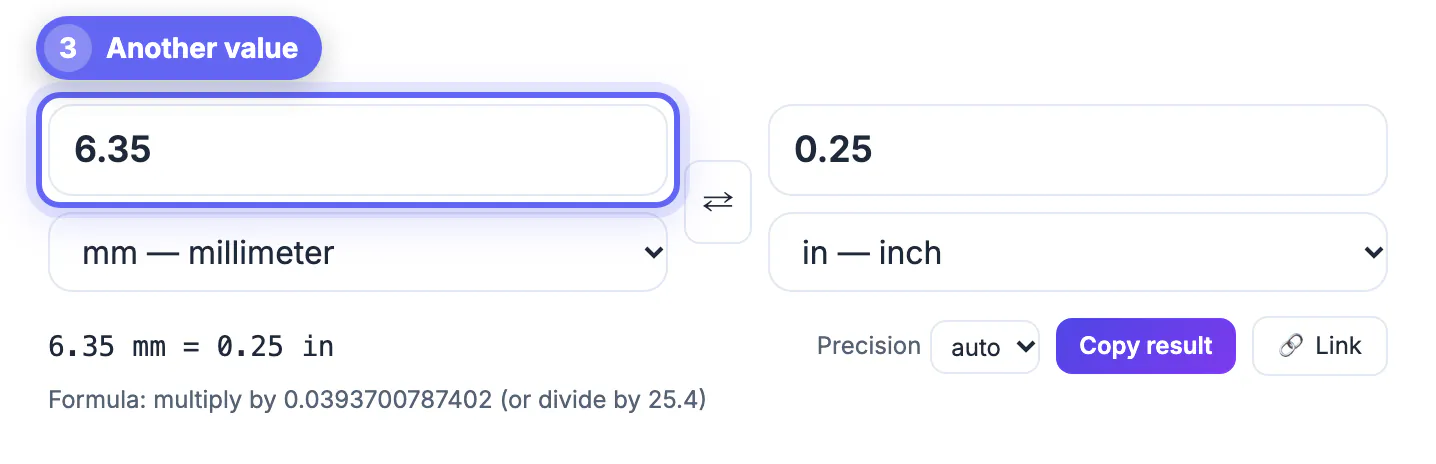
Exact matches are rare. 6.35 mm is a true 1/4 in, and 12.7 mm is a true 1/2 in, but most metric sizes fall between imperial ones. That is why a 6 mm bit will not fit a hole meant for a 1/4 in bit without a small gap.
Common sizes in millimeters and inches
Computed with the exact factor:
- 1 mm = 0.039 in
- 3 mm = 0.118 in
- 6.35 mm = 0.25 in (exactly 1/4 in)
- 8 mm = 0.315 in
- 10 mm = 0.394 in
- 12.7 mm = 0.5 in (exactly 1/2 in)
- 25 mm = 0.984 in
- 50 mm = 1.969 in
Camera and phone specs give more examples: a 35 mm lens focal length is 1.378 in, and a 2.5 mm audio jack is about 0.098 in. Whenever a metric size is standardized, it is rarely a round number in inches.
Working with tolerances
If a part is specified as 10 mm ± 0.1, the limits are 9.9 to 10.1 mm, which is 0.3898 to 0.3976 in. Convert each limit separately rather than converting the tolerance and adding it, and keep at least four decimals so you do not lose the small margin you are trying to check. When two parts have to fit together, convert both to the same unit before comparing them, and prefer to do the whole comparison in millimeters if either drawing already uses metric.
Reading a drill index and a caliper
In a workshop the two systems often sit side by side: a drill index lists fractional inch sizes while a digital caliper can switch between millimeters and inches at the press of a button. When you are matching a part to a hole, measure it in the unit the caliper shows first, then convert once, rather than converting a printed drawing value and a measured value separately. Keep track of which unit each number came from, because a mistaken unit is a far more common cause of a bad fit than an arithmetic slip.
If you often move between the two, note the handful of conversions you use most, such as the sizes of your favorite bits, on a small card kept with the tools. Write the millimeter value and the inch value together on the drawing, and note which one is the master, so that the person cutting the part knows which number to trust.
Where millimeters and inches collide
Metric parts used in an inch-based setup are common in cycling, plumbing, photography and 3D printing. A 50 mm lens filter is 1.97 in, a 6 mm hex key is about 0.236 in, and a 3 mm filament is about 0.118 in. The sizes are close to fractional inches but not identical, so check before substituting.
- Bike and car parts: a 10 mm socket does not fit a 3/8 in bolt perfectly, so use the correct size to avoid rounding off the head.
- Photography: sensor and lens measurements use millimeters, while print sizes use inches.
- 3D printing: slicers use millimeters, while many US models are designed in inches.
- Home projects: lumber is often named in inches, while hardware lists millimeters.
For larger measurements, converting cm to inches and converting inches to cm apply the same factor, while converting units correctly covers other kinds of measurement.
Keep enough digits for precision work
For machining or fitting parts, keep four decimals in inches and verify with a caliper. Rounding to two decimals can hide the difference between a loose and a tight fit.
A short practice set
Try these to check your method. A 5 mm drill bit is 0.197 in. A 20 mm pipe is 0.787 in. A 100 mm ruler section is 3.937 in. Each comes from dividing by 25.4, and the last digits rarely matter outside precision work. If you can estimate each one in your head first and then confirm with a calculator, you will quickly gain a feel for the numbers, which helps when reading product listings, checking spare parts or following a workshop tutorial written for another system.
Keep a small card with a few reference sizes near your bench, such as 6.35 mm for a quarter inch and 12.7 mm for half an inch. Having them at hand speeds up matching hardware and reduces mistakes caused by doing arithmetic with greasy hands. When precision matters, measure with a caliper, convert once and write the result in both systems on the drawing so everyone works from the same value.
Step-by-step
Common mistakes to avoid
Pro tips
Frequently asked questions
How many mm are in an inch?
There are exactly 25.4 millimeters in one inch.
What is 10 mm in inches?
10 mm is 0.3937 inches, about 25/64 in.
Is 6 mm the same as 1/4 inch?
No. 1/4 inch is 6.35 mm, so a 6 mm bit is 0.35 mm smaller than a 1/4 in bit.
How do I convert mm to fractions of an inch?
Divide by 25.4 for the decimal, multiply by the denominator you want (16 or 32) and round to the nearest whole number.
Can I convert many values at once?
The converter handles one value at a time; use the All units list to see every unit for the same value, and repeat for the next number.
Millimeters to inches is a division by 25.4, but real jobs usually need the nearest fraction too. Convert to a decimal first, check tolerances at four decimals and remember that only a few metric sizes, like 6.35 and 12.7 mm, match an imperial fraction exactly.
Related guides
Browse more: all calculator guides · Unit Converter