Calculate a Discount: 25% Off, Was/Now and Stacked (Free)
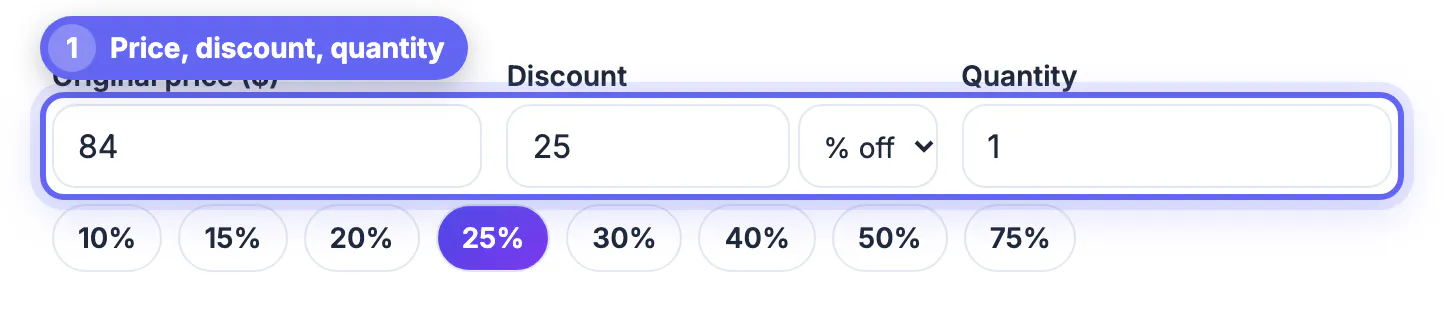
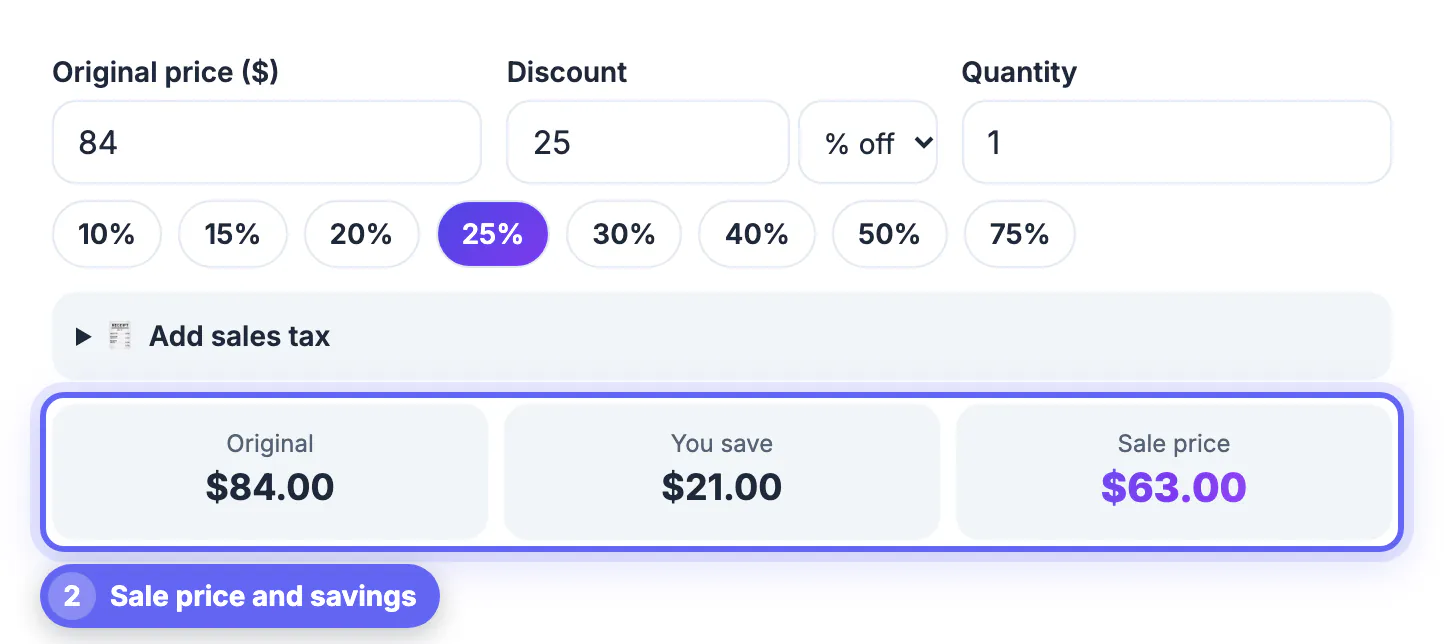
To calculate a discount, multiply the original price by the discount percentage as a decimal, then subtract that amount from the price. A jacket at $84 with 25 percent off saves 84 × 0.25 = $21 and costs $63. The same three numbers (price, savings, final price) answer almost every sale question, and two extra calculations cover the tricky ones: finding the real percentage from a was-and-now price, and working out what happens when two offers stack. This guide walks through each with GrabCast's free Discount Calculator, using screenshots of the real tool, and points out where sales tax and coupon order change the answer.
🏷️ Try the Discount Calculator now — freeOpen →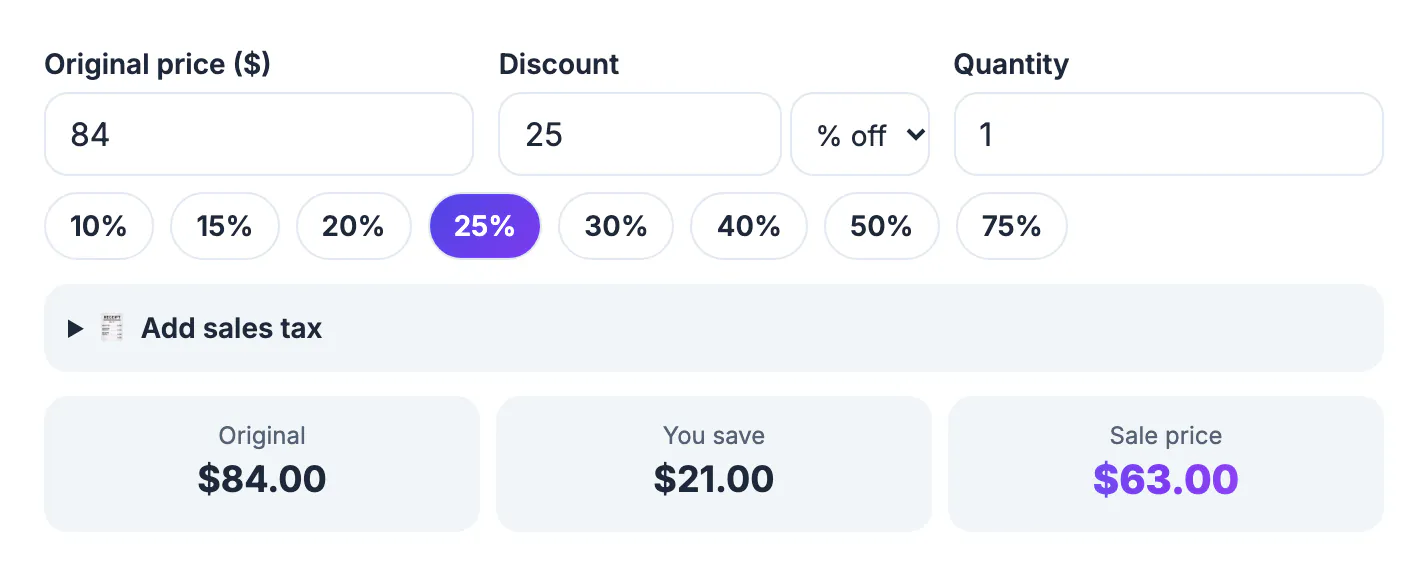
Sale tags are designed to be read quickly, and the headline percentage is not always what you actually save. A second coupon usually applies to the already-reduced price, a "was" price may never have been charged, and tax is added on top at the register. Ten seconds with the right formula tells you whether a deal is good, and lets you compare a percentage-off offer with a fixed-dollar coupon on the same item.
The discount formula
Convert the percentage to a decimal by dividing by 100, then use two lines:
- Savings = original price × discount %
- Sale price = original price − savings, or original price × (1 − discount %)
For $84 and 25 percent: 84 × 0.25 = $21.00 saved, and 84 − 21 = $63.00. The one-step version, 84 × 0.75 = $63, is faster once you know it: subtract the discount from 1 first (1 − 0.25 = 0.75) and multiply once.
Quick mental checks: 10 percent is the price with the decimal point moved one place, 50 percent is half, and 25 percent is half of half. For $84, 10 percent is $8.40, so 30 percent is $25.20.
Finding the real percent off from a was and now price
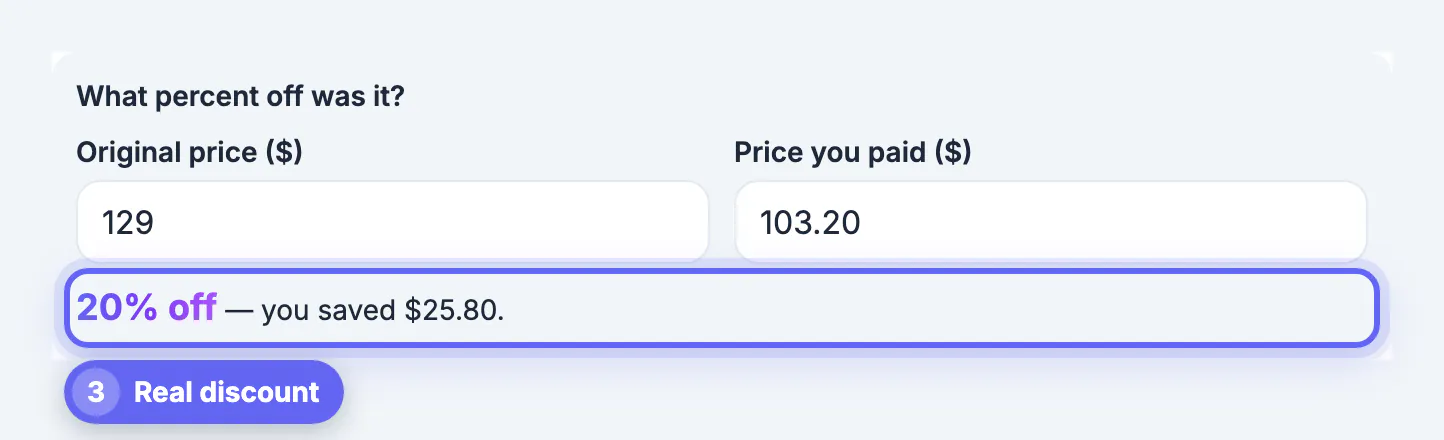
Tags often show only two prices. The percentage is the drop divided by the original: (original − sale) ÷ original × 100. With an original of $129 and a price you pay of $103.20, the saving is $25.80 and 25.80 ÷ 129 = 0.20, so it is 20 percent off. In the calculator, use the Find % off tab, enter both prices and the result appears below them.
Only compare against a real recent price. A high "was" price that was never charged makes any percentage look big, so check the price history or another store before you trust it.
Stacked discounts are not added together
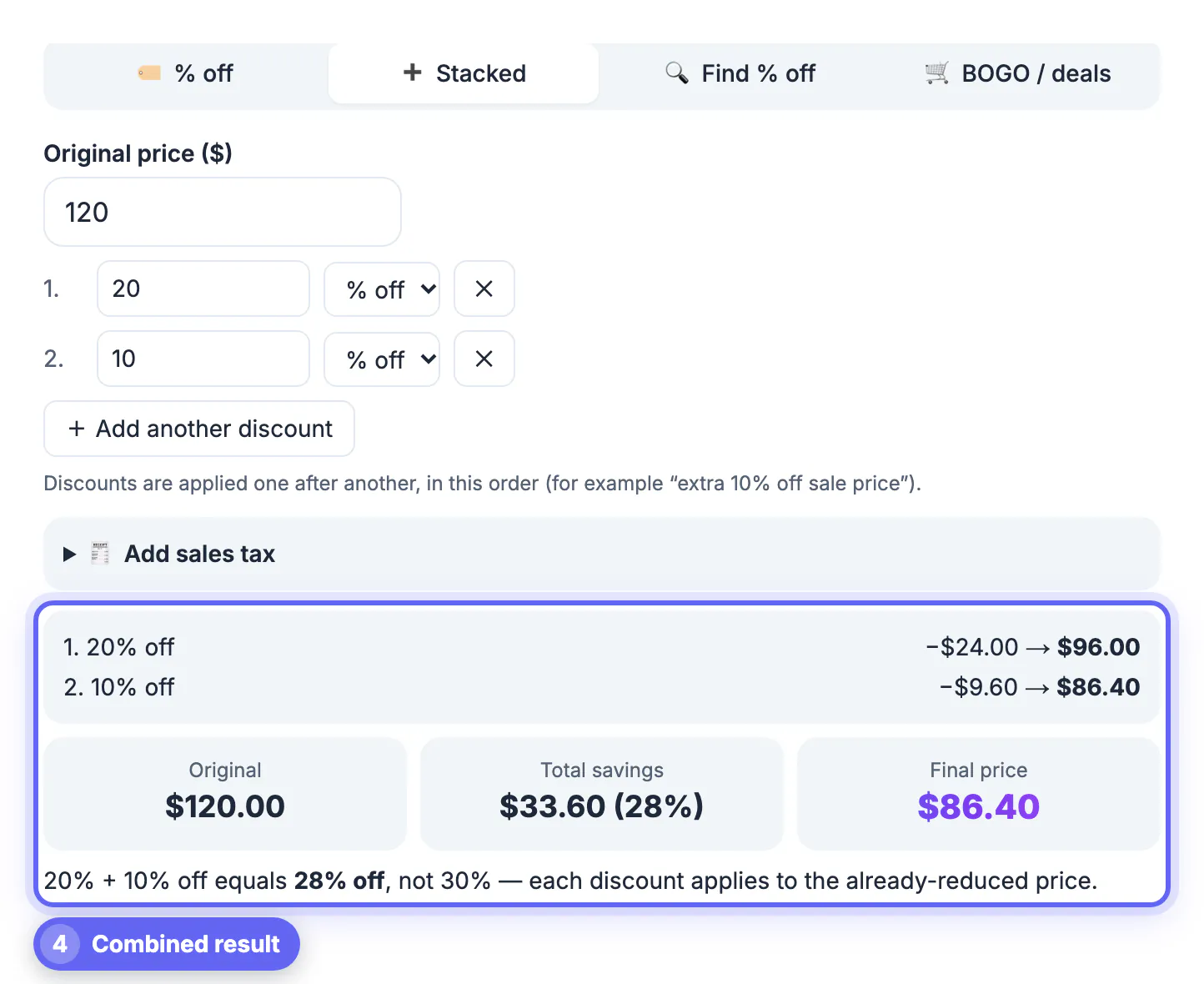
When a store takes 20 percent off and then a coupon takes another 10 percent, the discounts apply one after the other, not together. On a $120 item, 20 percent off is $96.00 and 10 percent off that is $86.40. Total savings are $33.60, which is 28 percent, not 30. The Stacked tab in the calculator lists each step, and it also shows what happens if the order changes: percentage-off coupons taken first leave a smaller dollar coupon a larger share of the price.
A fixed-dollar coupon and a percentage coupon are the case where order matters most, so check the store's terms for which is applied first.
Sales tax and quantity
In most US states sales tax is charged on the discounted price, so a $63 jacket at an 8 percent rate costs 63 × 1.08 = $68.04. Rules differ by state and by coupon type (a manufacturer's coupon can be taxed differently from a store discount), so treat the calculator as an estimate and check the receipt. The calculator has an Add sales tax option and a quantity box, so buying three of the same item at 25 percent off is one line: enter the quantity and read the total.
For a broader guide to percentages see How to Calculate a Percentage.
Comparing offers that look different
Stores present savings in several ways, and the best deal is not always the largest number. A $30 coupon off a $120 item equals 25 percent, while 30 percent off a $90 item saves $27. Buy-one-get-one at half price on a $40 item saves $10 on two, or 12.5 percent overall.
- Divide the amount saved by the original total to compare offers fairly.
- Check minimum spend and exclusions on coupons before you rely on them.
- Include shipping and tax in the final price.
- Remember that a price you would not pay without the sale is not a saving.
To understand how a rise and fall compare, percentage increase and decrease shows why a 20 percent rise is not undone by a 20 percent fall, and calculating sales tax covers the final charge at checkout.
Quick mental checks
Ten percent is one decimal place to the left, so 10 percent of $84 is $8.40. Twenty percent is double that, and 25 percent is a quarter. Use these anchors to sanity-check the calculator.
A short practice set
Try these to check your method. A $60 jacket at 30 percent off costs $42, saving $18. A $250 monitor at 15 percent off costs $212.50. A $80 pair of shoes at 40 percent off then another 10 percent off costs $43.20, not $40. Work out each one in your head first and then confirm with a calculator. The final example shows why stacked offers deserve a second look, because the second percentage applies to the already reduced price.
Build the habit of checking the final total, not the headline percentage. Add delivery, tax and any membership fee, then divide by the number of items. A smaller discount on a product you truly need beats a bigger one on something you would not buy at full price. Keep a short note of prices you have seen over the last months, which makes it easier to tell a real bargain from a marketing label.
Step-by-step
Common mistakes to avoid
Pro tips
Frequently asked questions
How do I calculate 25 percent off?
Multiply the price by 0.25 to get the savings and subtract it, or multiply the price by 0.75 for the sale price. For $84 that is $21 saved and $63 to pay.
How do I find the discount percentage from two prices?
Subtract the sale price from the original, divide by the original and multiply by 100. From $129 to $103.20 is 20 percent.
Are 20% off and then 10% off the same as 30% off?
No. On $120 they give $86.40, which is 28 percent off. The second discount applies to the already-reduced price.
Is sales tax added before or after the discount?
In most US states it is charged on the discounted price, but rules vary by state and coupon type, so check your receipt.
Is the Discount Calculator free?
Yes. It runs in your browser with no sign-up and no limit.
Discount math is one multiplication: price × (1 − percent) gives the sale price. Use the Find % off tab to check a was-and-now tag, the Stacked tab when offers combine, and remember that two percentages never simply add.
Related guides
Browse more: all calculator guides · the Discount Calculator