Convert Units Correctly: Gallons, Ounces, Tons and More
To convert units correctly, first confirm which definition your source means, then multiply by an exact factor rather than a rounded one: an inch is exactly 2.54 cm, a pound is exactly 0.45359237 kg and a US gallon is exactly 3.785411784 liters. Most wrong answers come from labels, not arithmetic, because gallon, pint, ounce, ton, cup and gigabyte each name two or three different amounts. This guide lists those traps, shows why area, temperature and fuel economy break simple multiplication, and explains how GrabCast's free Unit Converter handles its 15 categories so you can check a result in seconds.
📏 Try Unit Converter now — freeOpen →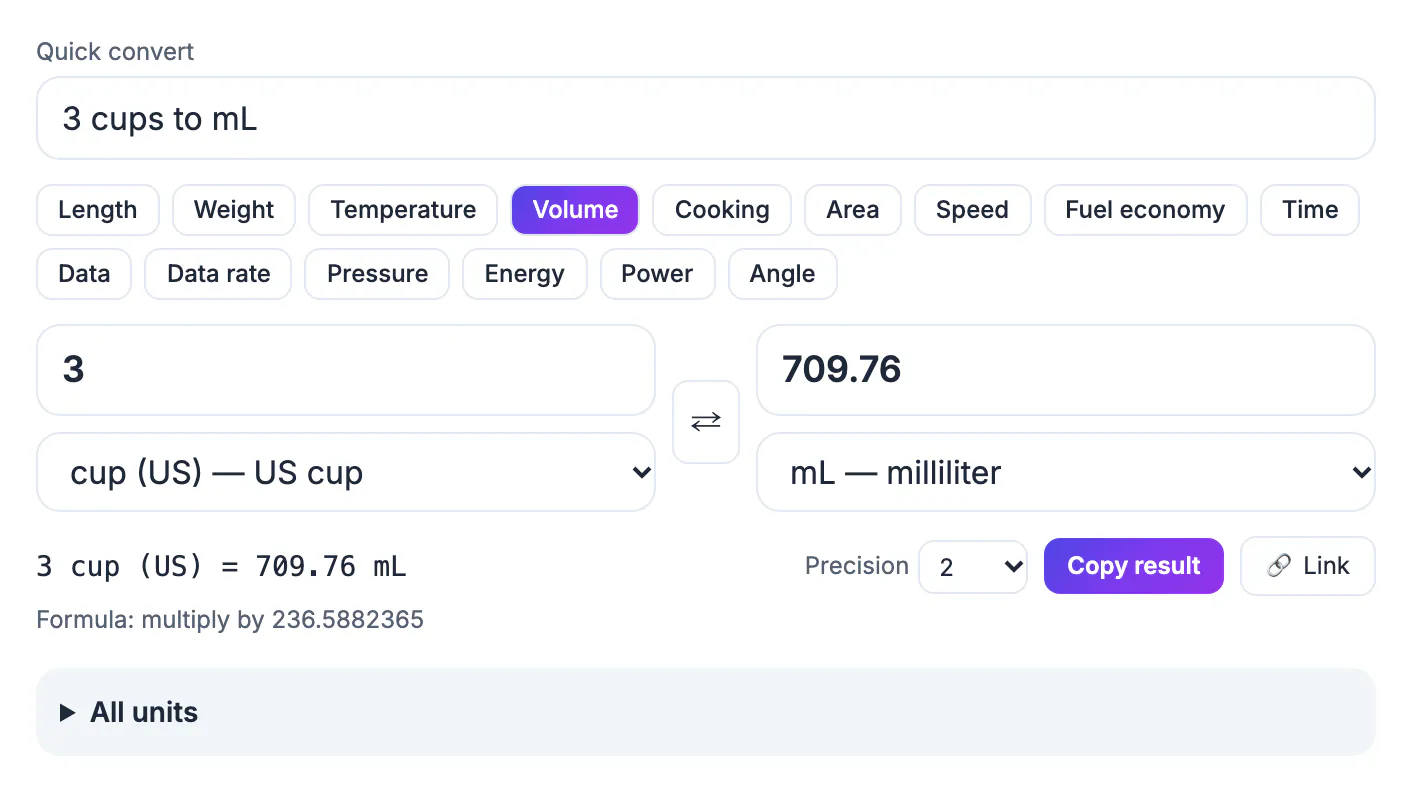
A wrong factor rarely looks wrong on paper. Measure a British recipe's pint of stock with a US pint and you pour 16.7 percent less liquid. Read a freight quote in US short tons as metric tonnes and the load is 9.3 percent lighter than you planned for. In 1983 an Air Canada Boeing 767 ran out of fuel mid-flight because the fuel load was worked out in pounds instead of kilograms, and in 1999 NASA lost the Mars Climate Orbiter after one team supplied pound-force seconds to software expecting newton-seconds. Household stakes are smaller, a sunken cake or an underfilled paint order, but the root cause is identical: a number traveled without a clear label.
What the Unit Converter covers across 15 categories
GrabCast's converter is organized as tabs, and each tab lists the measures people actually run into, using the exact legal definitions published by NIST and the international SI rather than rounded textbook values.
- Length, Weight, Area and Volume: meters to nautical miles, carats to long tons, square inches to square miles and acres, and both US and imperial gallons, quarts, pints and fluid ounces, plus cubic feet and cubic inches.
- Temperature, Cooking and Fuel economy: Celsius, Fahrenheit, Kelvin and Rankine; US teaspoons, tablespoons, US cups and 250 mL metric cups; mpg (US), mpg (UK), L/100 km and km/L.
- Speed, Time, Pressure, Energy and Power: mph, knots and Mach; milliseconds to years; psi, bar, atm and inches of mercury; calories, kcal, kWh and BTU; mechanical horsepower, metric PS and kilowatts.
- Data, Data rate and Angle: decimal kB, MB, GB and TB next to binary KiB, MiB, GiB and TiB, bits, Mbps against MB/s, and degrees, radians, gradians, arcminutes and turns.
A few entries rest on stated assumptions, and knowing them keeps you honest. Mach uses the speed of sound at sea level and 15 °C, 340.29 m/s, so it is not valid at cruising altitude. A month is the Gregorian average of 30.436875 days and a year is 365.2425 days, which suits rough planning but not payroll or interest math. Horsepower means mechanical horsepower of about 745.7 W, while the European PS is 735.49875 W, a gap of roughly 1.4 percent that shows up when comparing car brochures.
Names that mean two or three different amounts
Double-check these words whenever a figure comes from another country, an old cookbook or a trade with its own conventions.
- Gallon and pint: a US gallon is 3.785411784 L and an imperial gallon 4.54609 L, about 20 percent more; a US pint is 473.176473 mL and an imperial pint 568.26125 mL.
- Ton: a metric tonne is 1,000 kg, a US short ton 907.18474 kg and a British long ton 1,016.0469088 kg; shipping, scrap and mining contracts often use different ones.
- Ounce: a weight ounce is 28.349523125 g, a US fluid ounce is a volume of 29.5735295625 mL, and a UK fluid ounce is 28.4130625 mL.
- Cup and gigabyte: a US cup is 236.5882365 mL, a metric cup 250 mL and a US nutrition-label cup 240 mL; a GB is a billion bytes while a GiB is 1,073,741,824.
The ounce trap is the one that ruins baking. A US cup of water weighs about 236 grams, but a cup of all-purpose flour weighs roughly 120 to 125 grams because flour is far lighter for its volume, and packed brown sugar is heavier again. No calculator can turn a volume into a weight without the ingredient's density, which is why the Cooking tab converts spoons, cups and milliliters among themselves and nothing more. For flour, sugar or butter, use a gram-per-cup chart from a trusted baking source, or better, weigh.
Convert units that do not scale in a straight line
Four kinds of quantity cause most of the confusion in homework, home projects and car shopping, because a single multiplier is either not enough or plainly wrong.
- Area and volume scale by the square and the cube: 1 m is 3.28084 ft, but 1 square meter is 10.7639 square feet and 1 cubic meter is 35.3147 cubic feet.
- Temperature has an offset: 20 °C is 68 °F, yet a rise of 20 Celsius degrees is a rise of 36 Fahrenheit degrees, with no 32 involved.
- Fuel economy flips: mpg measures distance per fuel, L/100 km measures fuel per distance, so 30 mpg (US) is 7.84 L/100 km and doubling mpg halves the liters.
- Storage has two conventions: drive makers count a gigabyte as a billion bytes, while Windows divides by 1,073,741,824, so a 1 TB drive appears as about 931 GB.
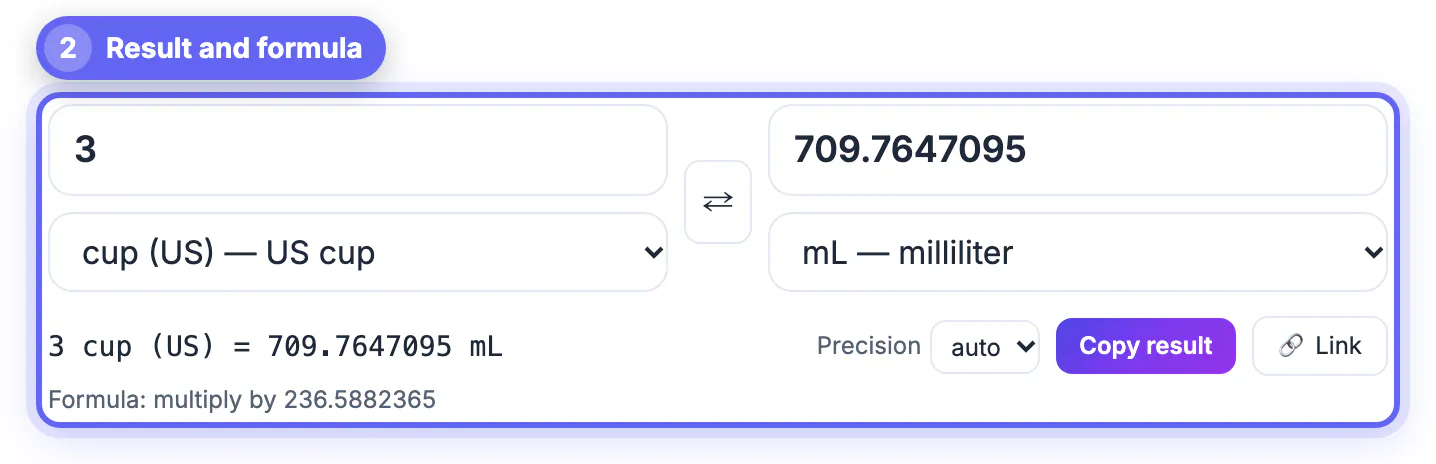
The converter's formula line spells out what it is doing for each pair. For straight multiplications it prints the factor, for example multiply by 10.7639104167 when going from square meters to square feet. For temperature it shows the rule, such as °F = °C × 9/5 + 32, and for fuel economy it reminds you that a lower L/100 km figure is the better one. One honest limit: the Temperature tab converts readings, meaning a thermometer value. For a change, such as an oven running 15 degrees hot, multiply by 9/5 or 5/9 yourself and skip the 32.
For temperature, which is the classic non-linear case, see the worked guides on Celsius to Fahrenheit and Celsius to Kelvin.
Anchors that expose a wrong answer fast
Before trusting any result, compare it with one of these mental anchors. If the converter and your estimate disagree by more than a few percent, the cause is almost always a wrong tab, a swapped direction or the wrong flavor of gallon, not the math.
- 1 mile is exactly 1.609344 km, so 65 mph is 104.6 km/h and a 5K race is 3.107 miles.
- 1 kg is 2.20462 lb, and a 14 lb stone is exactly 6.35029318 kg.
- 35 psi, a common car tire pressure, is 2.413 bar or 241.3 kPa.
- 1 kWh is 3,412.14 BTU, and 1 mechanical horsepower is 0.7457 kW.
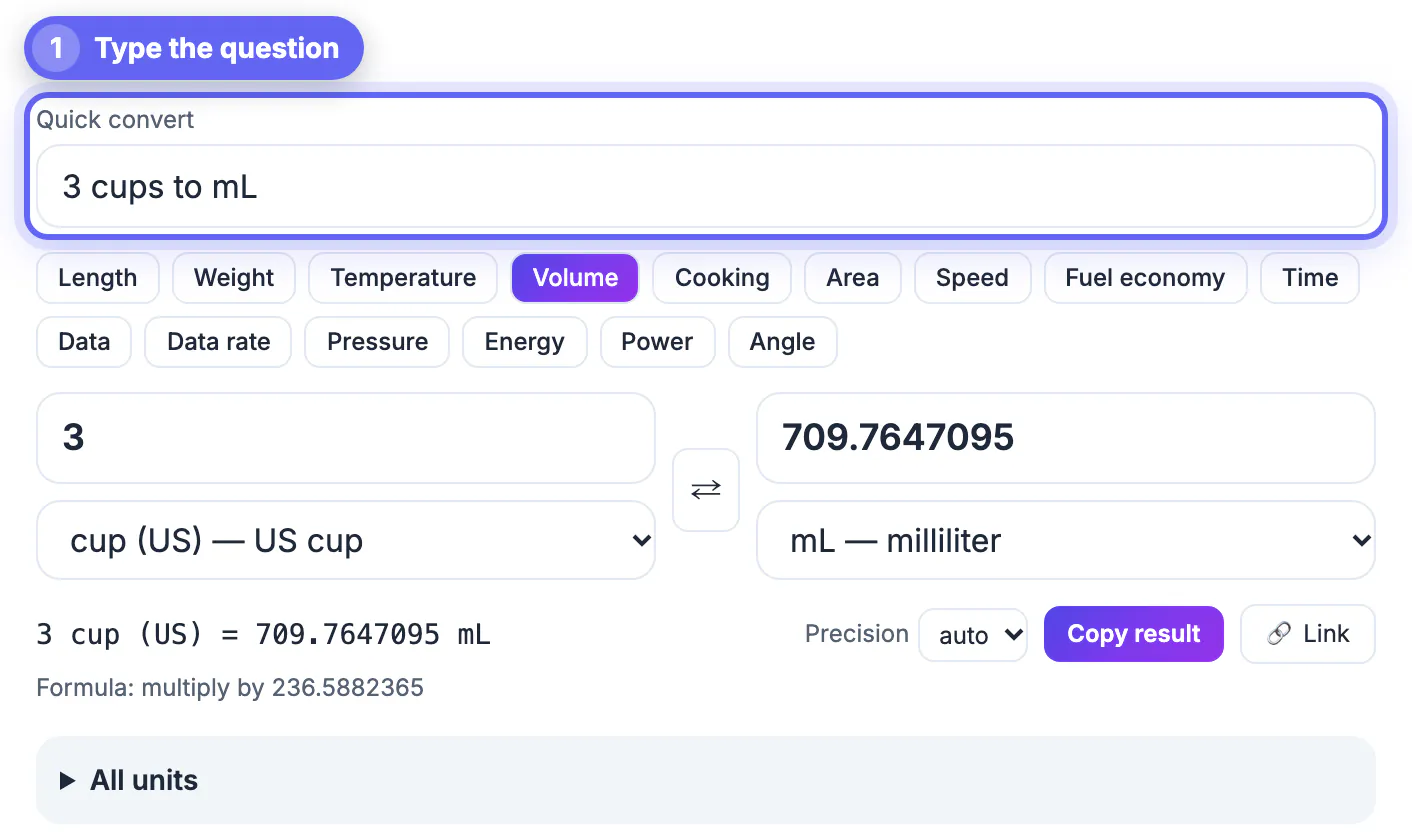
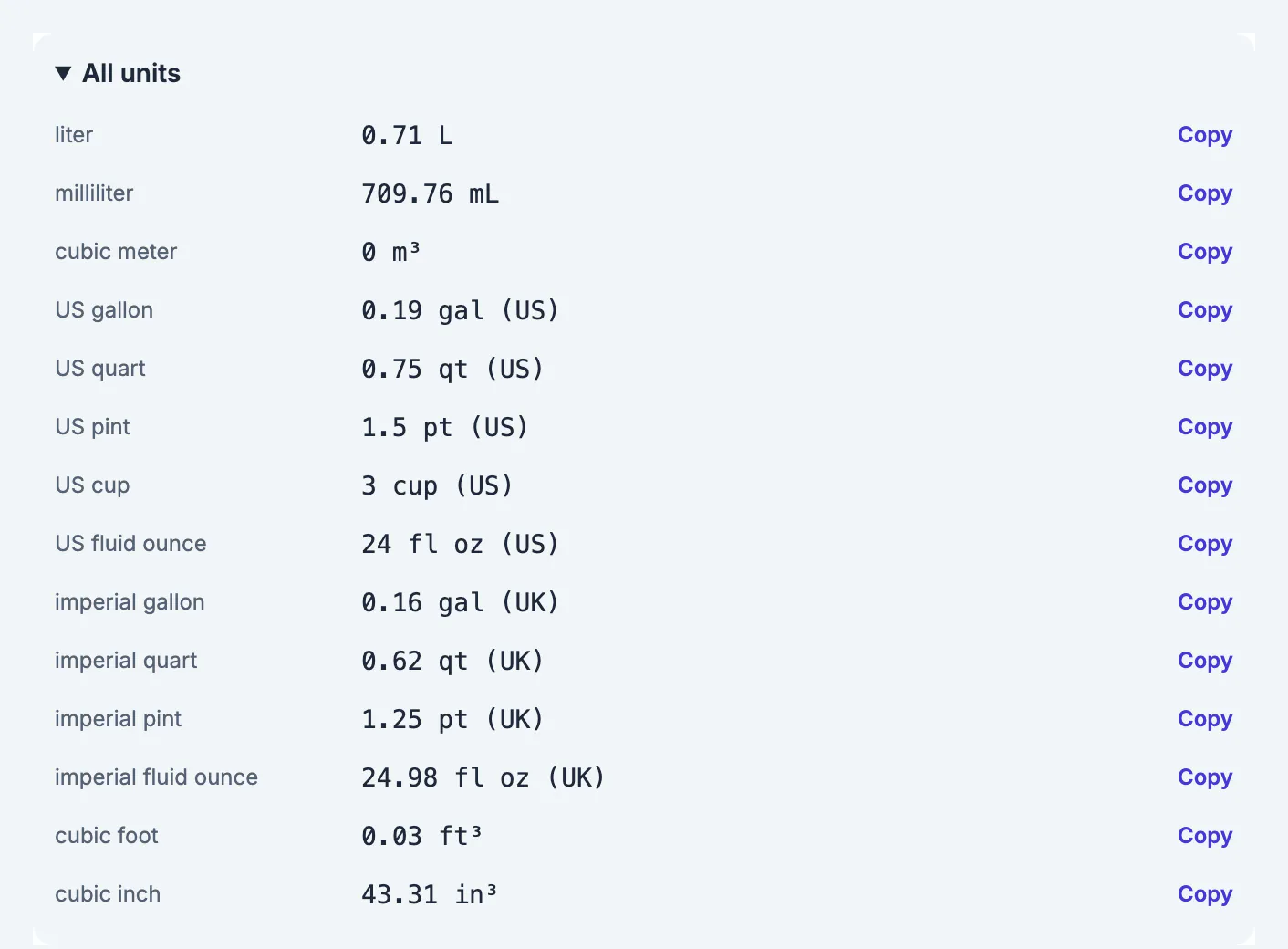
You do not have to hunt through tabs to test an anchor. Type the whole question into the Quick convert box, for instance 35 psi to bar or 3 cups to mL, and the tool jumps to the right category with both units selected. The two value boxes work in either direction, the All units panel lists the same quantity in every unit of the category with a Copy button on each row, and the Link button copies a URL that reopens exactly that conversion for a colleague. Everything is calculated by JavaScript on your own device.
Step-by-step
Common mistakes to avoid
Pro tips
Frequently asked questions
Does the tool use US or imperial gallons?
Both. The Volume tab lists US and imperial gallons, quarts, pints and fluid ounces separately, and the Cooking tab adds US teaspoons, tablespoons, US cups and metric cups.
Which ton does the converter mean?
All three are listed: the metric ton of 1,000 kg, the US short ton of 907.18474 kg and the British long ton of 1,016.0469088 kg, alongside stone and carats.
Why does my 1 TB drive show about 931 GB?
Makers count 10^12 bytes, while Windows divides by 1,073,741,824 per gigabyte. The Data tab shows both: 1 TB equals 931.32 GiB.
Can I turn cups of flour into grams?
Not with any pure unit converter, because volume to weight depends on density. Use an ingredient chart; all-purpose flour runs roughly 120 to 125 grams per US cup.
How precise are the results?
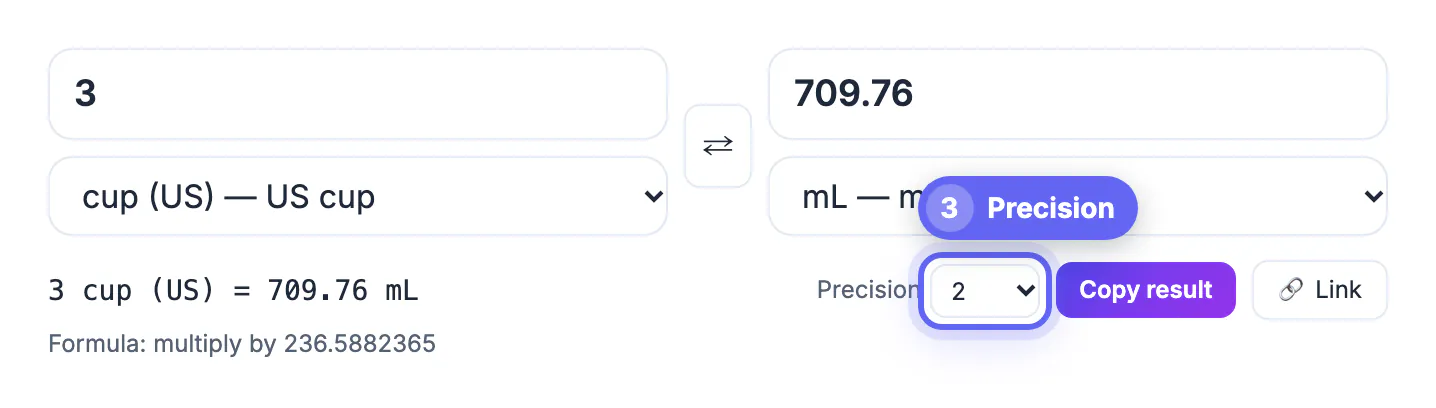
Factors are exact definitions, auto mode shows up to 10 significant digits, and you can fix output at 2, 4, 6 or 10 decimal places. In auto mode, extreme values switch to scientific notation.
Arithmetic is the easy part; labels are the risk. Confirm which gallon, pint, ounce, ton, cup or gigabyte your source means, remember that areas square the factor, temperature changes skip the 32 and fuel economy inverts, and check each answer against a memorized anchor before you rely on it.
Related guides
Browse more: all calculator guides · Unit Converter