How to Convert Pounds to kg (Formula + Quick Trick)
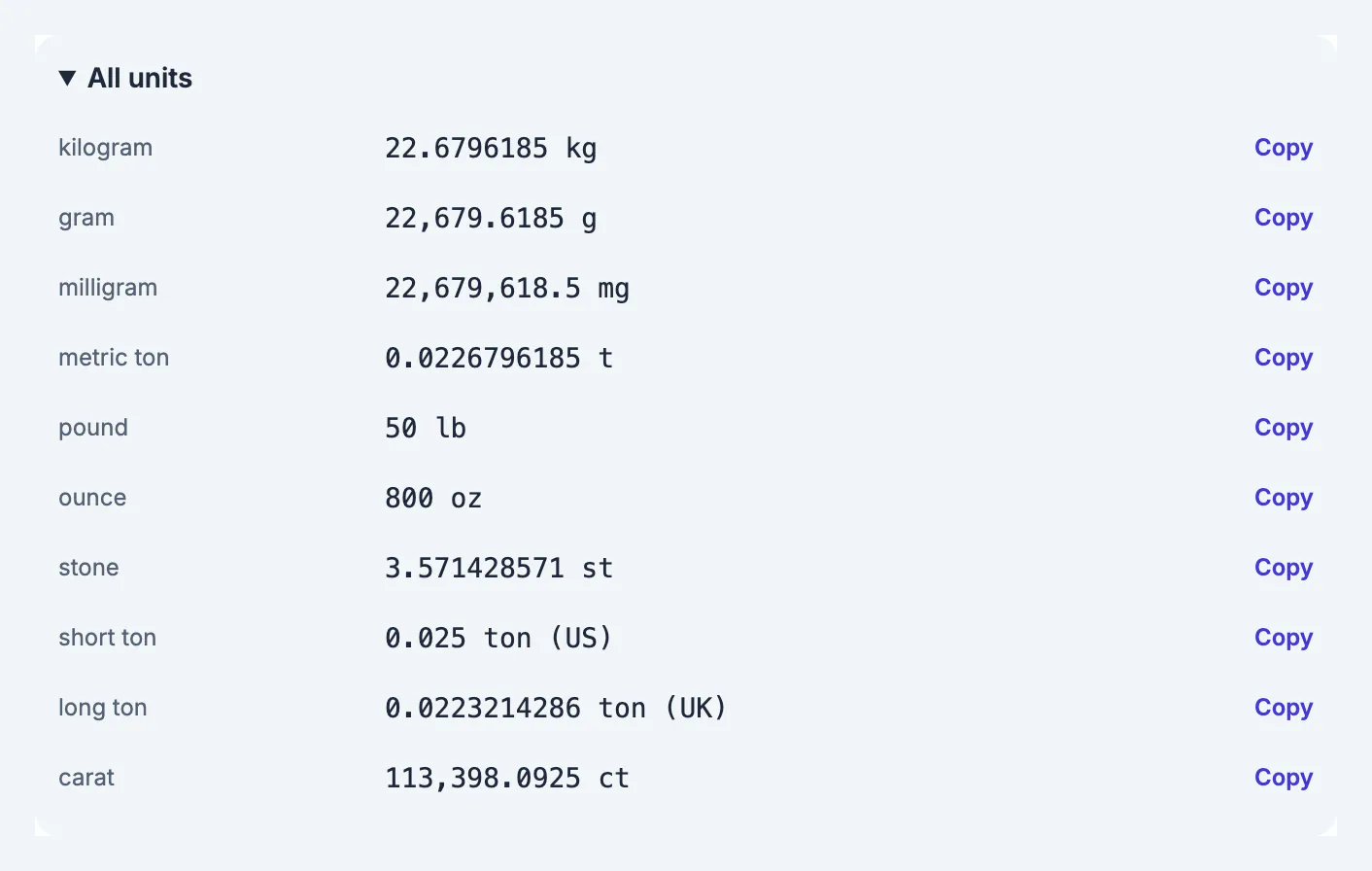
To convert pounds to kilograms, multiply the pounds by 0.45359237, or divide by 2.20462. A 150 lb person is 150 × 0.45359237 = 68.04 kg and a 50 lb suitcase is 22.68 kg. Pounds remain the everyday weight unit in the United States, so the conversion is what you need for a foreign passport form, a medication or a baby-weight chart from a doctor abroad, an international parcel, a fitness program or a recipe written for a European kitchen. This guide covers the exact factor, a mental shortcut, everyday weights, ounces and stone, and the steps in GrabCast's free Unit Converter with screenshots.
⚖️ Try Unit Converter now — freeOpen →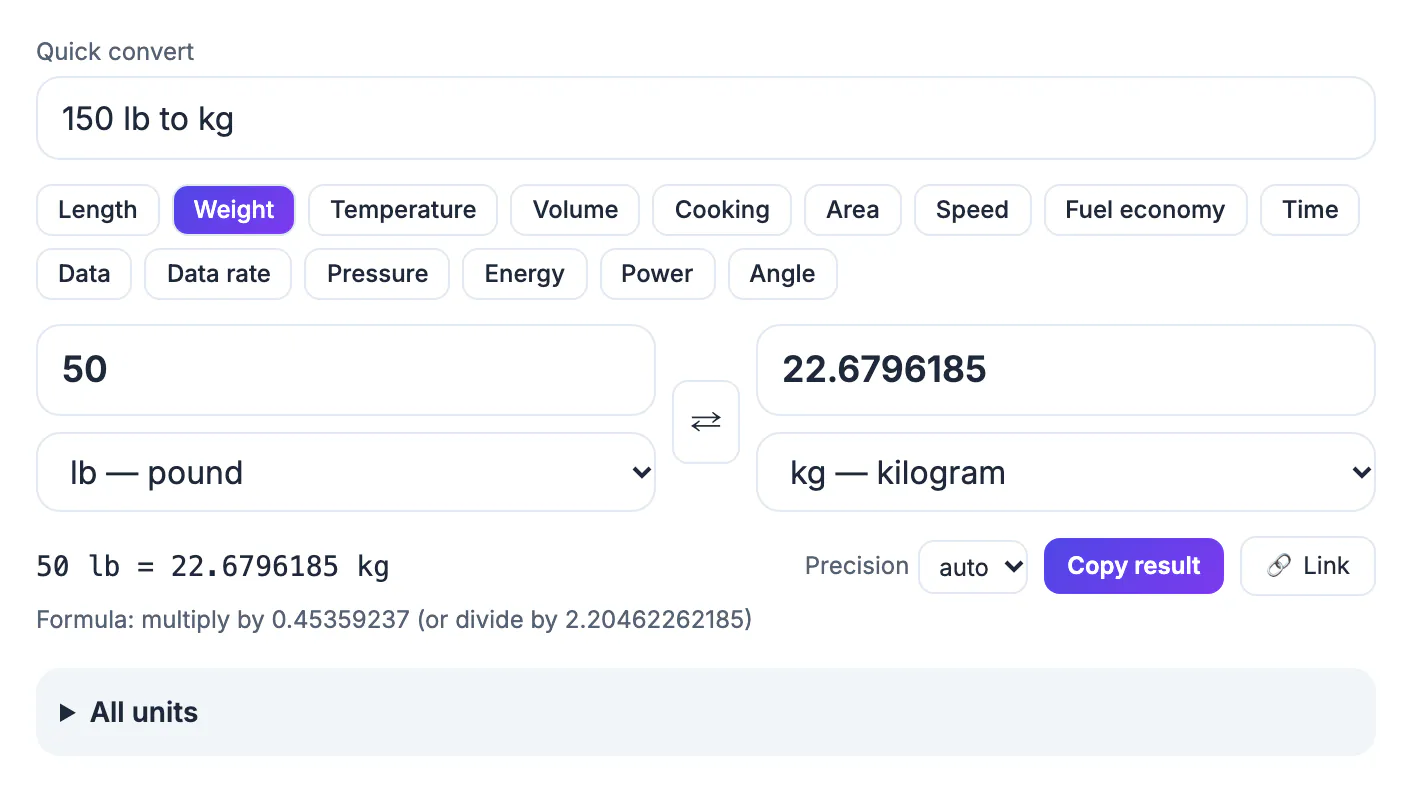
Going from pounds to kilograms makes the number smaller, so a mistake is easy to spot in one direction and easy to miss in the other: dividing by 2.2 gives the right answer, but multiplying by 2.2 gives a number more than twice too large. It also matters more than it looks. Doses for babies and pets, luggage limits and courier price bands are set in kilograms, and being one or two kilograms out can change a result.
The pounds to kg formula
Use kilograms = pounds × 0.45359237, or pounds ÷ 2.20462. Both are the same rule: the pound is defined as exactly 0.45359237 kg. The reverse is pounds = kilograms × 2.20462.
Example: 150 lb × 0.45359237 = 68.0388555 kg, which the converter shows unrounded. For a form, 68 kg is a normal rounding; for a dose, keep the decimals the prescriber gives.
A shortcut for the head
Halve the pounds and subtract 10 percent of that half: 150 lb → 75 → minus 7.5 = 67.5 kg, against the true 68.04. It is about 0.8 percent low, which is fine for weight estimates but not for a limit. If you want a closer figure, multiply by 0.454 instead: 150 × 0.454 = 68.1 kg.
Everyday weights in pounds and kilograms
Computed with the exact factor:
- 1 lb = 0.45 kg
- 8 lb = 3.63 kg (a newborn, about)
- 10 lb = 4.54 kg
- 25 lb = 11.34 kg
- 45 lb = 20.41 kg (a standard barbell, about 20 kg)
- 50 lb = 22.68 kg (a common airline bag limit)
- 150 lb = 68.04 kg
- 200 lb = 90.72 kg
A US Olympic barbell weighs 45 lb (20.41 kg), but the bar itself is manufactured as 20 kg, so its label in pounds is rounded. Plates are labeled the same way, so a 45 lb plate is 20.41 kg, while a 20 kg plate is really 44.09 lb.
Ounces, stone and mixed units
A pound is 16 ounces, so 8 lb 6 oz is 8.375 lb and 3.799 kg. Baby weights are often quoted this way: convert the ounces to a decimal by dividing by 16, add them to the pounds, then multiply by 0.45359237. British body weights use stone: 11 st 4 lb is (11 × 14) + 4 = 158 lb, or 71.67 kg. Convert everything to pounds first and then use one multiplication.
A worked example: a dose and a discharge weight
A vet gives a dose per kilogram, and your pet's weight is 42 lb on the clinic's US scale. Convert first: 42 × 0.45359237 = 19.05 kg. A dose of 5 mg per kilogram is then 95 mg, whereas using 42 directly would give 210 mg, more than double. (Always follow your vet's or doctor's own instructions; this only shows the arithmetic.) This is the standard reason clinics ask for kilograms: always convert the weight first, then apply the per-kilogram rule, and never round the kilogram figure before multiplying.
Making medication and pet-care numbers safe
Doses that depend on body weight are always calculated in kilograms, so the conversion step is a safety step. Write down the weight in both units, the date and the scale that was used, and pass the kilogram figure to whoever is calculating the dose. Never round the weight before the calculation, and let a professional confirm any dose. If a label lists a pounds figure and your calculation uses kilograms, convert once, carefully, and check it by converting back.
The same habit helps with everyday tasks such as ordering equipment by weight or checking a delivery weight, where a unit slip can mean a wrong price band. Keep a short log of the weights and the conversions you used, so that a second person can verify the numbers before anything is ordered, dosed or shipped.
Everyday moments that need this conversion
Pounds appear on US bathroom scales, gym plates, grocery labels and shipping forms. A 5 lb bag of potatoes is 2.27 kg, a 25 lb dumbbell is 11.34 kg, and a 7.5 lb newborn is 3.40 kg. If you read a recipe from an American site, 2 lb of beef is about 907 g.
- Travel: check luggage in kilograms if the airline publishes the limit that way.
- Fitness: tracking apps usually let you pick a unit; switch before you log data.
- Online shopping: product weights decide shipping cost, so convert before comparing.
- Pets and babies: record the weight with its unit every time.
For the reverse conversion, kilograms to pounds shows the formula and a shortcut, and converting units correctly covers other everyday measures.
Choosing how many decimals to keep
One decimal is enough for body weight and groceries, two for parcels and dosing checks. Do not round until the final step of any multi-part calculation.
Practical checks before you rely on a figure
Whenever a number comes from a label, a scale or a form, take a moment to confirm what it describes. Ask whether it is gross or net, whether packaging is included, and whether the scale was calibrated. Mixed sources are a frequent cause of mismatches: a kitchen scale, a post office scale and a clinic scale can differ by a few hundred grams. Writing both versions next to each other, with the date and the source, makes it easier to repeat the measurement and explain a difference.
For anything involving health, dosing or safety limits, follow the figures given by a professional and not a rounded estimate. Keep the original reading on record in case a clinician or a carrier asks to see it.
A short practice set
Try these to check your method. A 12 lb turkey is 5.44 kg. A 180 lb person is 81.65 kg. A 40 lb bag of soil is 18.14 kg. Each comes from multiplying by 0.45359237, and the last digits rarely matter outside dosing or shipping. Estimate each first, then confirm with a calculator, so you build a feel for the numbers.
Step-by-step
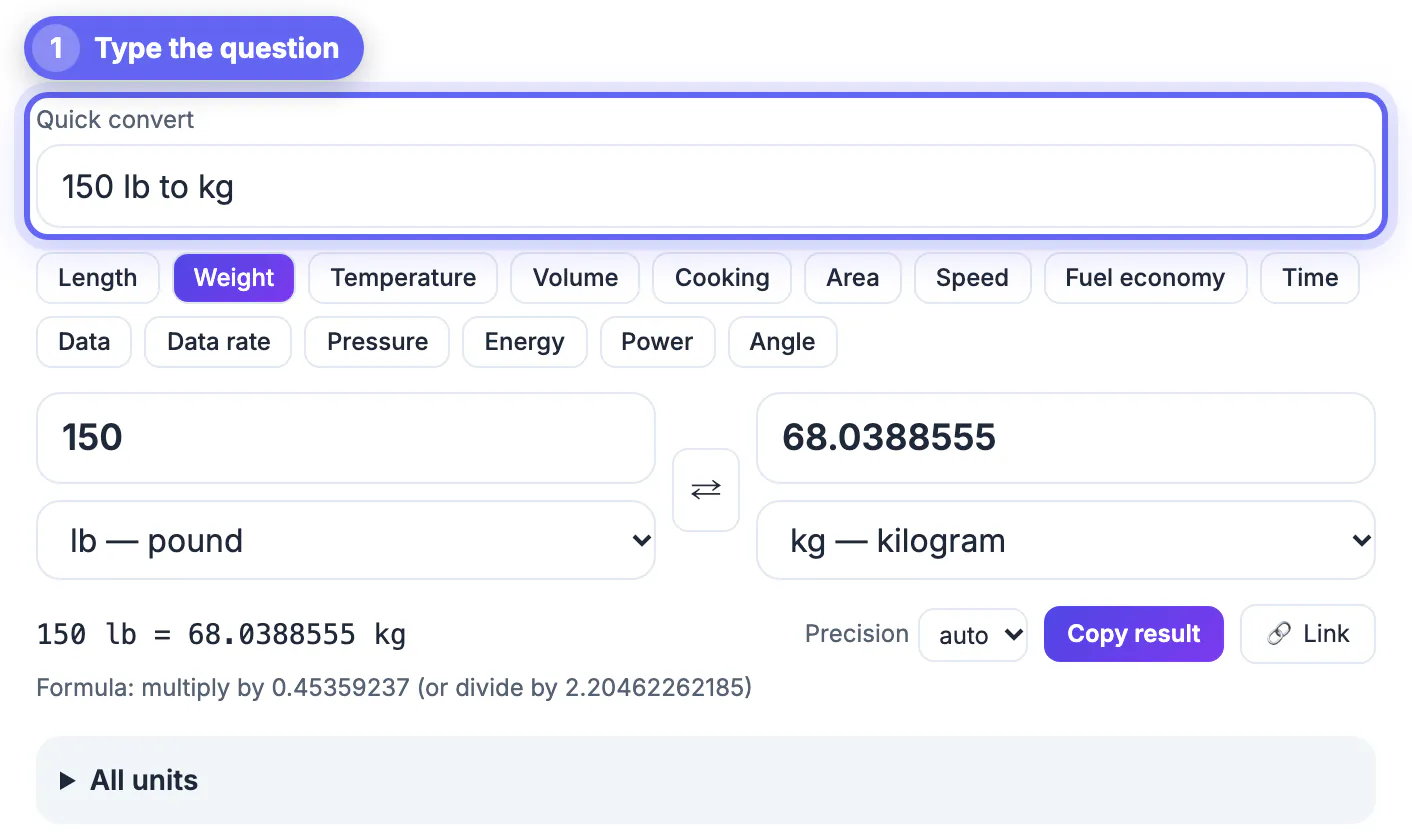
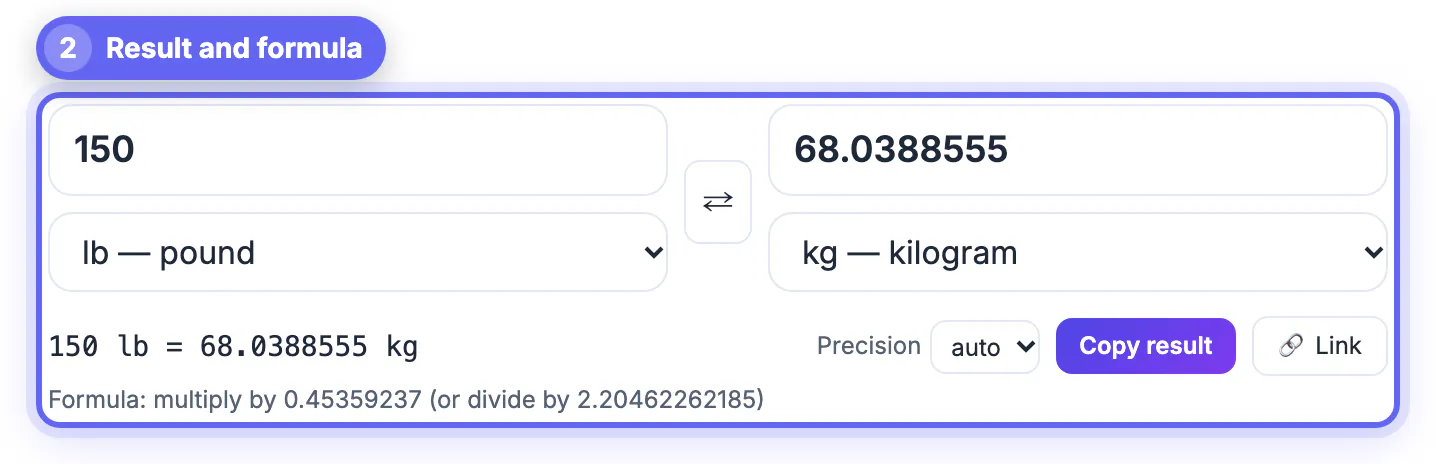
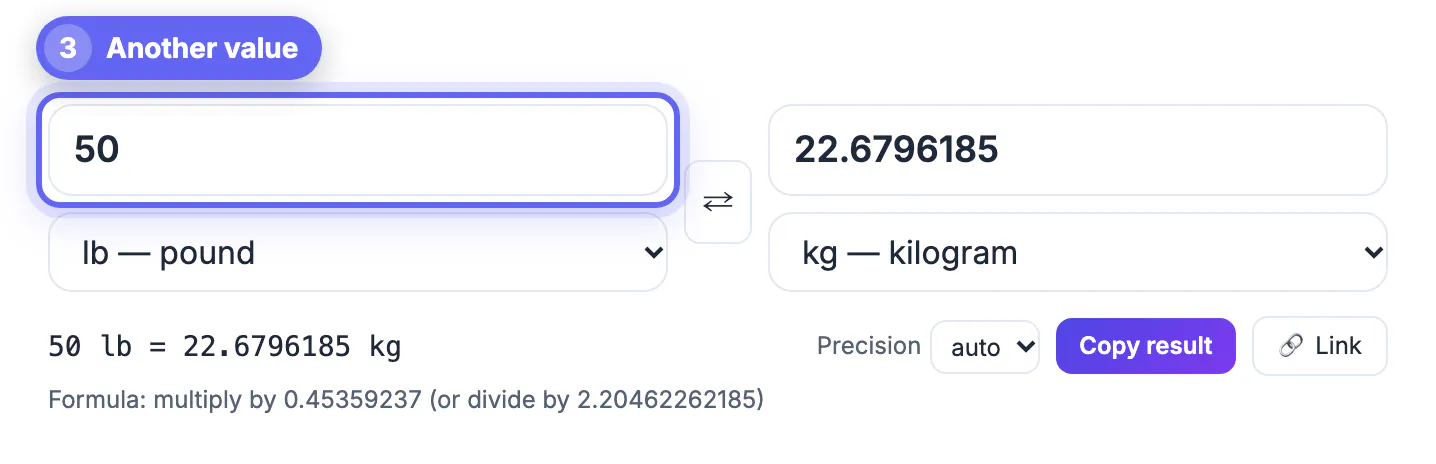
Common mistakes to avoid
Pro tips
Frequently asked questions
How many kg is 1 pound?
One pound is 0.45359237 kilograms, or about 454 grams.
What is 150 lb in kg?
150 pounds is 68.04 kilograms.
How do I convert pounds and ounces to kg?
Divide the ounces by 16, add them to the pounds and multiply by 0.45359237. 8 lb 6 oz is 8.375 lb, which is 3.8 kg.
Is 50 lb within a 23 kg limit?
Yes. 50 lb is 22.68 kg, just under 23 kg. 51 lb is 23.13 kg and is over.
Is the factor exact?
Yes. The pound is defined as exactly 0.45359237 kg, so only your rounding adds error.
Pounds to kilograms is a multiplication by 0.45359237 (or a division by 2.20462). Estimate by halving and trimming a tenth, use the exact factor near limits and doses, and convert ounces or stone to pounds before you start.
Related guides
Browse more: all calculator guides · Unit Converter