How to Convert Kilograms to Pounds (Formula + Quick Trick)
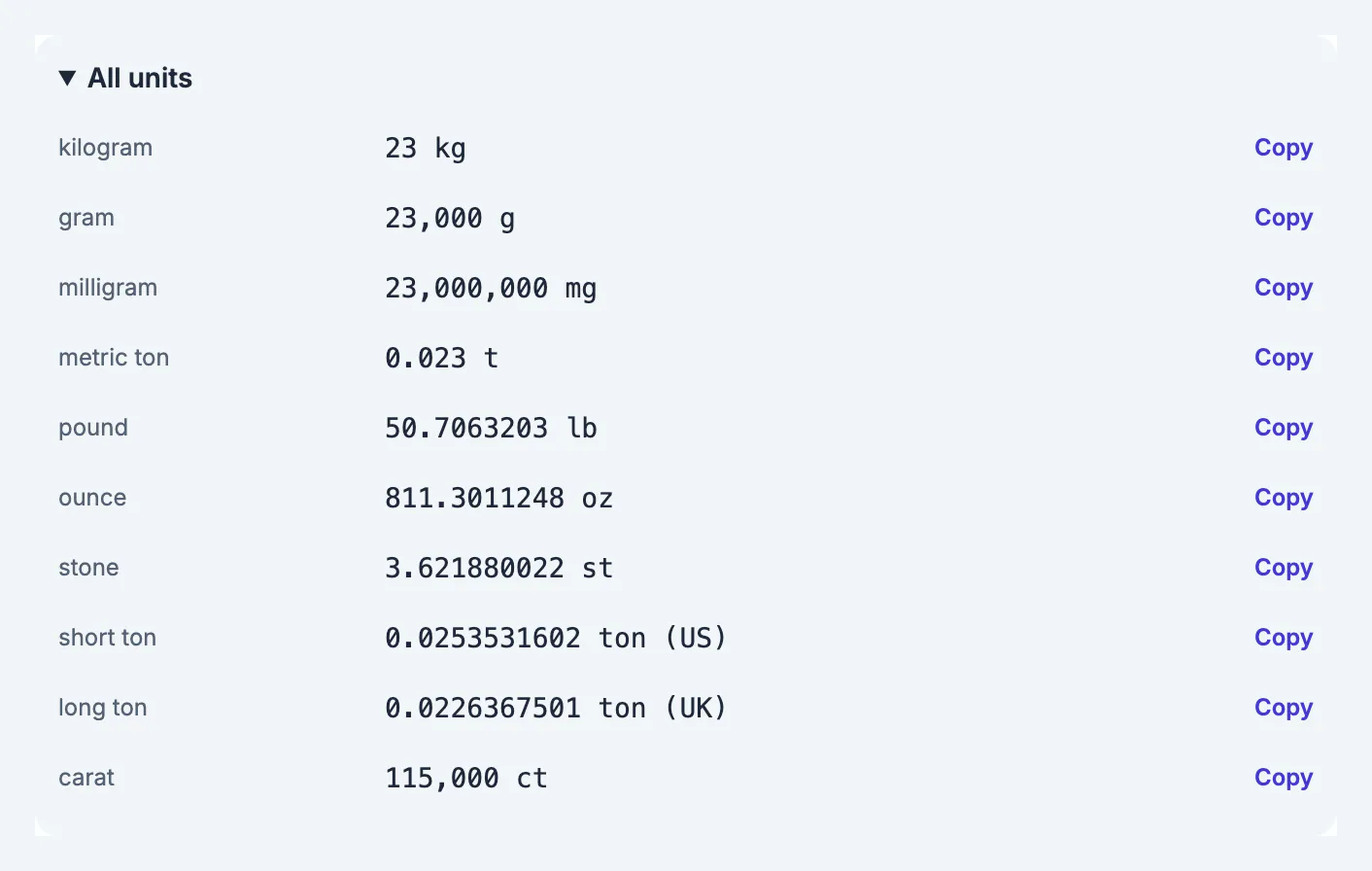
To convert kilograms to pounds, multiply the kilograms by 2.20462. A 70 kg person weighs 70 × 2.20462 = 154.32 lb, and a 23 kg checked bag is 50.71 lb. Kilograms are used for body weight, food and luggage in most of the world, while the United States still uses pounds for people, groceries and gym plates, so the conversion comes up for travelers, lifters, recipe readers and anyone shipping a parcel abroad. This guide gives the exact factor, a doubling shortcut, a list of weights people convert most, an explanation of the 50 lb airline limit and the steps in GrabCast's free Unit Converter, shown with real screenshots.
⚖️ Try Unit Converter now — freeOpen →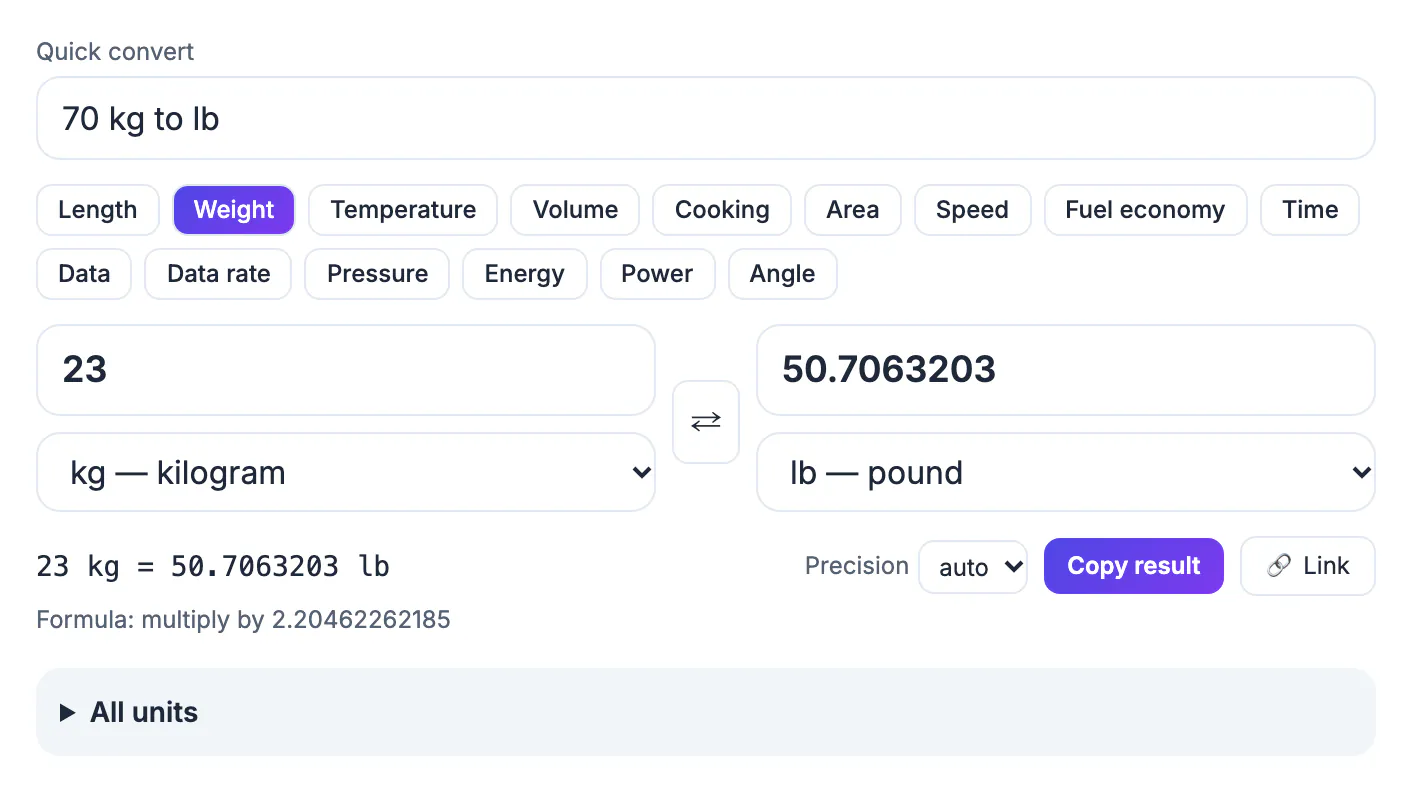
For most conversions being a little off is harmless, but weight has hard limits: an airline surcharge starts at a specific number, a shipping tier changes at a specific number, and a lifting program lists loads to the pound. Rounding kilograms to pounds by doubling is close, but it gives 46 lb for a 23 kg bag when the true value is 50.7 lb, which is the difference between an unremarkable bag and a fee at the counter.
The kg to lb formula
Use pounds = kilograms × 2.20462. The exact factor is 2.2046226218, because the pound is defined as 0.45359237 kg. To go back, kilograms = pounds ÷ 2.20462 or pounds × 0.45359237.
Example: 70 kg × 2.20462 = 154.32 lb. The converter shows 154.3235835 because it uses more digits.
The doubling shortcut and its error
Double the kilograms and add 10 percent of that result: 70 kg → 140 → +14 = 154 lb, against the exact 154.32. This is far better than doubling alone (140 lb), which is 9 percent too low. For a number like 23 kg the trick gives 46 + 4.6 = 50.6 lb, within 0.1 lb of the true 50.71.
Weights people convert most
Computed with the exact factor:
- 1 kg = 2.2 lb
- 5 kg = 11.02 lb
- 10 kg = 22.05 lb
- 20 kg = 44.09 lb
- 23 kg = 50.71 lb (a common checked-bag limit)
- 32 kg = 70.55 lb (a common heavy-bag limit)
- 70 kg = 154.32 lb
- 100 kg = 220.46 lb
Gym plates are the classic example: a 20 kg barbell is 44.09 lb, and a 25 kg plate is 55.12 lb. Lifters in the US who read a European program will find the loads look odd in pounds because plates are made in kilograms, so plan the loading in kilograms and convert only to check.
Luggage, parcels and body weight
Many airlines set economy checked-bag limits around 23 kg (50.7 lb) and a heavy-bag limit around 32 kg (70.5 lb), but the numbers vary by airline and fare, so check your booking. Because the 23 kg limit is 50.7 lb, a bag that a US scale reads as 51 lb is already over. Weigh it with the kilogram setting if your scale has one, or convert the reading and compare.
Body weight in pounds is also often written in stone and pounds in the UK: 70 kg is 154.3 lb, which is 11 st 0.3 lb. If a form asks for stones, divide the pounds by 14; the whole number is the stone and the remainder the pounds.
A worked example: sharing a parcel
You are posting a 6.4 kg box to a friend in the US, and the carrier's price bands are in pounds. 6.4 × 2.20462 = 14.11 lb. If the band ends at 14 lb, the parcel is over, so take out a small item of about 110 g: the box is then 6.29 kg, which is 13.87 lb, before you pay. Converting first saves a surcharge that would only be discovered at the counter.
Weighing things you will send or carry
Weigh a bag or parcel on a scale that shows the unit you need, and check it a second time after repacking. Kitchen and bathroom scales can differ by a few hundred grams, and airline scales may differ again, so leave a small margin under a limit rather than sitting exactly on it. If a limit is written in one unit and your scale shows another, convert the limit rather than the reading, and write the converted limit on a note attached to the bag.
For shared trips, agree on a single unit in advance so that everyone packs to the same number and nobody is surprised at the check-in desk. A quick note with the weight in both units, taped to the bag, saves an argument at the counter and lets a colleague repack it without recalculating anything. If you are unsure which scale to trust, weigh a known object such as a sealed bag of flour or sugar first; the difference from its printed weight tells you how far the scale is off.
Cooking, gym and shipping examples
Kitchen scales, barbells and parcels all list weights in different systems. A 2 kg bag of flour is 4.41 lb, a 20 kg Olympic bar is 44.09 lb, and a 0.5 kg letter pack is 1.10 lb. Gym plates labelled in kilograms add up differently from those in pounds, so a 100 kg squat equals about 220 lb.
- Shipping: carriers round up to the next pound, so a 1.01 lb parcel may be billed as 2 lb.
- Gym: a 45 lb plate is 20.4 kg, close to but not equal to a 20 kg plate.
- Recipes: ounces and grams are tidier than pounds and kilograms for small amounts.
- Medicine and vet doses use kilograms; convert with care.
For the opposite direction, pounds to kg has the matching formula, and stone to kg and pounds covers British body weights.
Rounding for the situation
Use one decimal for body weight, two for parcels near a limit, and more only when a specification demands it. Always round in the direction that keeps you within a limit.
Practical checks before you rely on a figure
Whenever a number comes from a label, a scale or a form, take a moment to confirm what it describes. Ask whether it is gross or net, whether packaging is included, and whether the scale was calibrated. Mixed sources are a frequent cause of mismatches: a kitchen scale, a post office scale and an airline scale can differ by a few hundred grams. Writing both versions next to each other, with the date and the source, makes it easier to repeat the measurement and explain a difference.
For anything involving health, dosing or safety limits, follow the figures given by a professional and not a rounded estimate.
Step-by-step
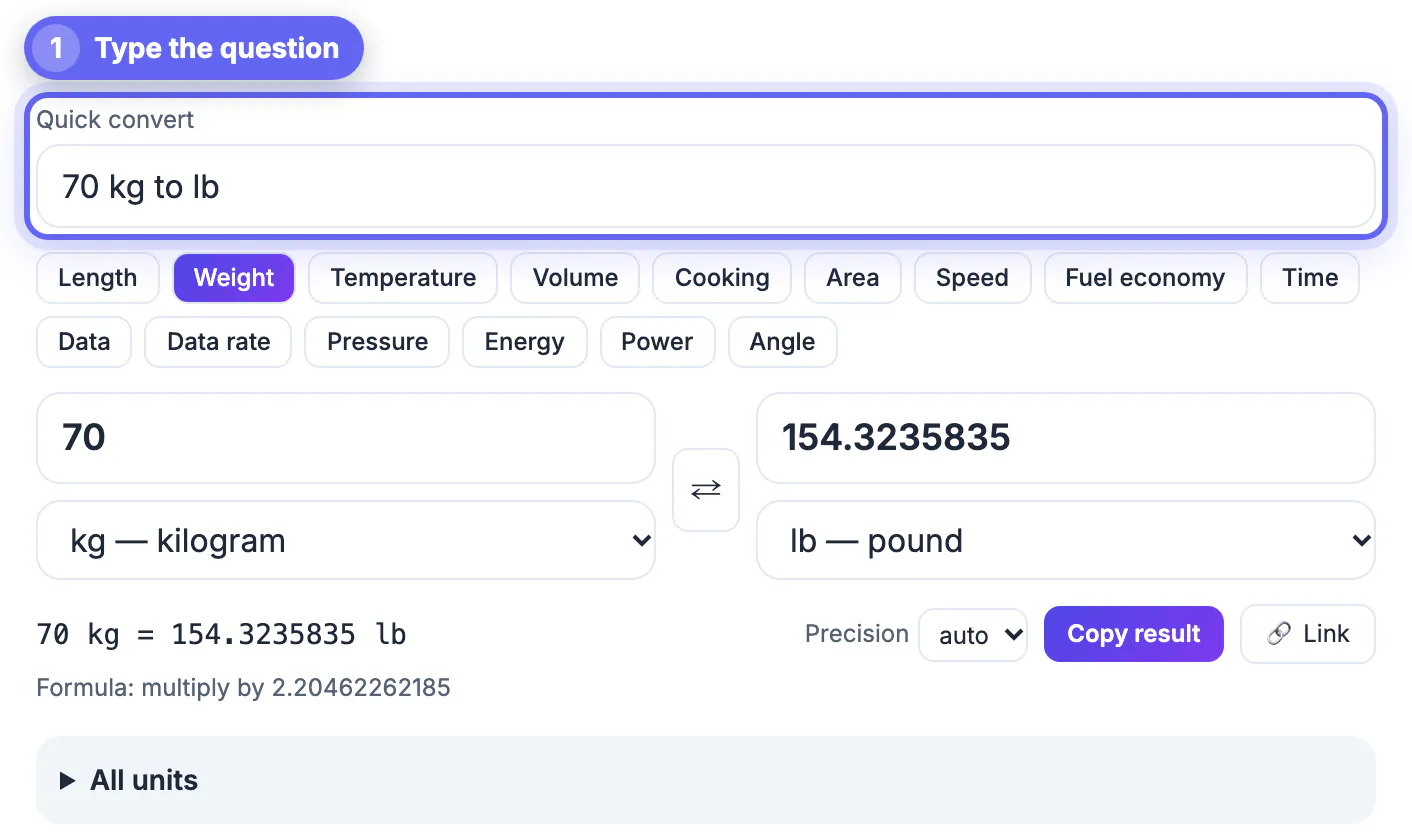
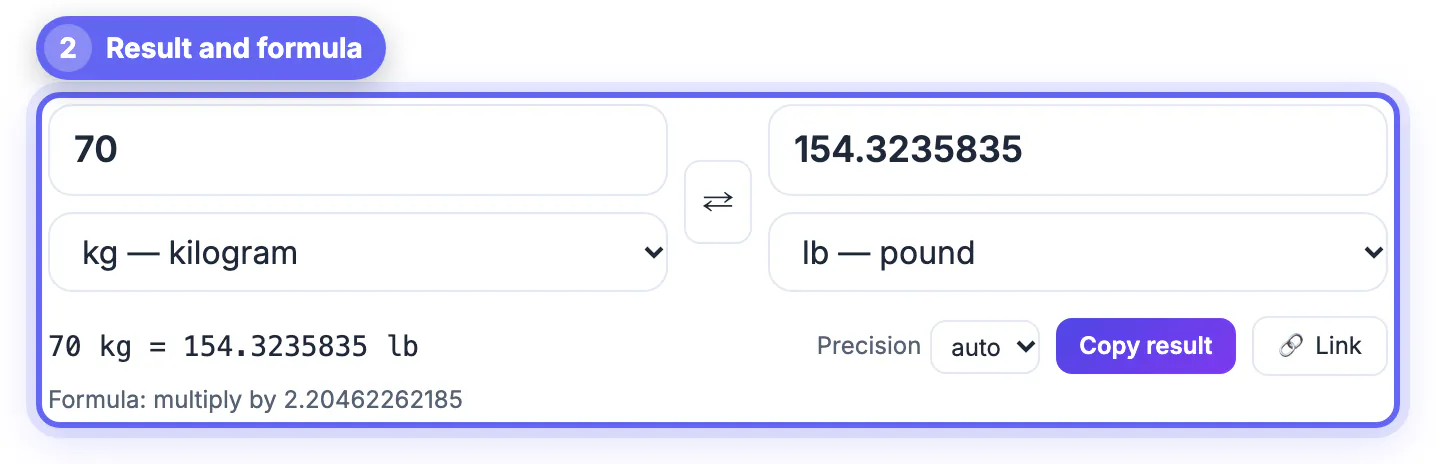
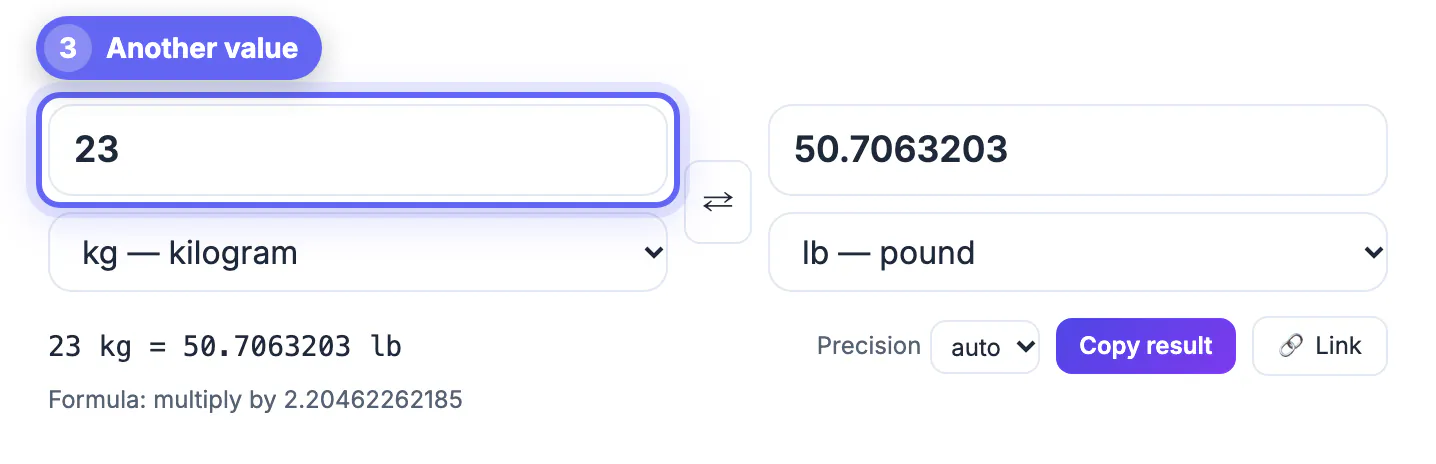
Common mistakes to avoid
Pro tips
Frequently asked questions
How many pounds are in a kilogram?
One kilogram is 2.20462 pounds.
What is 70 kg in pounds?
70 kg is 154.32 lb, or about 11 stone.
Is 23 kg the same as 50 lb?
Almost. 23 kg is 50.71 lb, so a bag at 50 lb is about 22.7 kg. If a limit is 23 kg, 50 lb fits, 51 lb does not.
How do I convert quickly in my head?
Double the kilograms and add 10 percent of the result.
Is the Unit Converter free?
Yes. It runs in the browser, needs no account and shows the exact factor.
Kilograms to pounds is a multiplication by 2.20462. Use double-plus-ten-percent for quick estimates, the exact factor when a limit is near, and the converter's All units list when a form wants ounces or stone.
Related guides
Browse more: all calculator guides · Unit Converter