How to Convert Miles to Kilometers (Formula + Quick Trick)
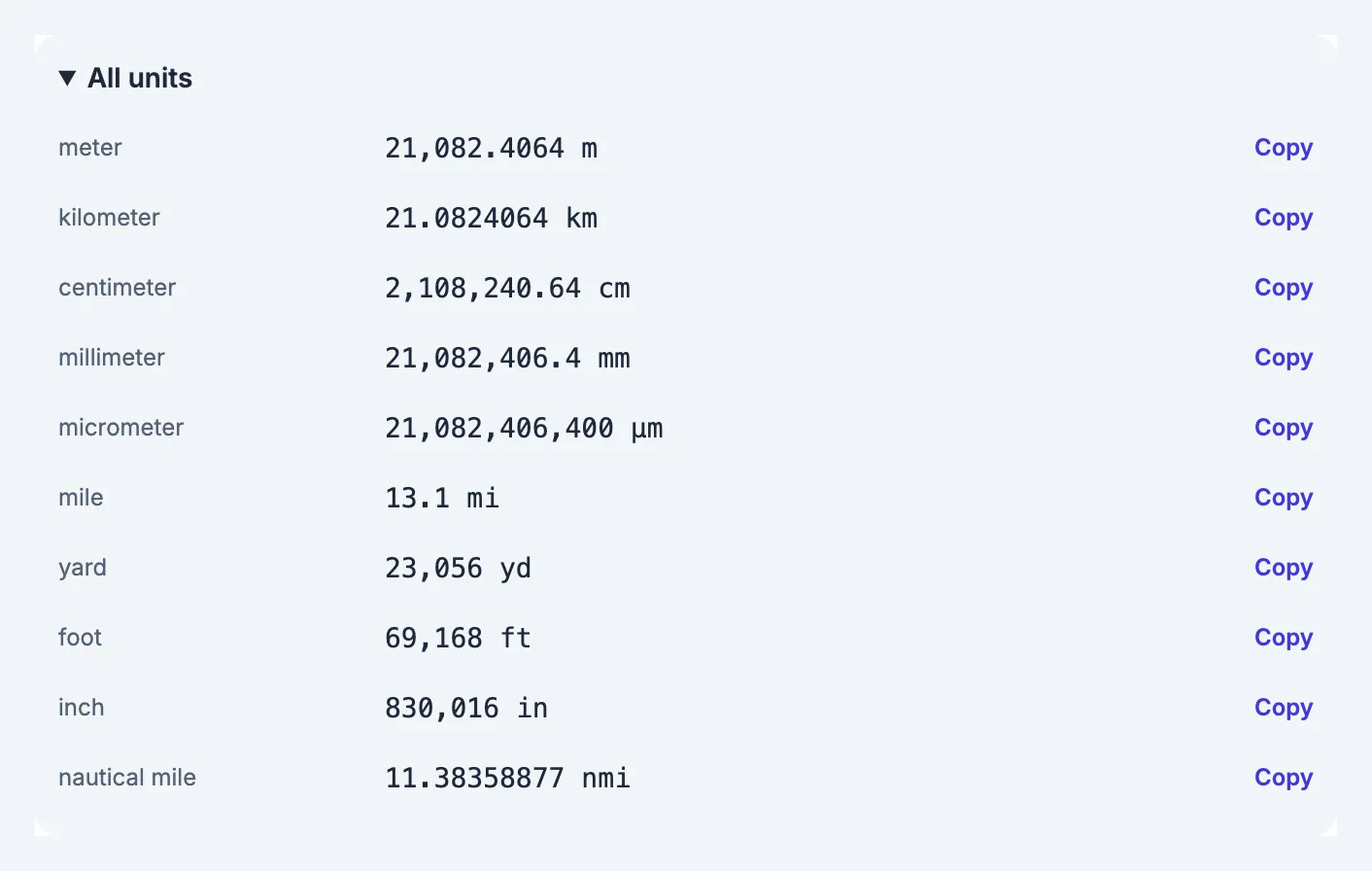
To convert miles to kilometers, multiply the miles by 1.609344. A marathon of 26.2 miles is 26.2 × 1.609344 = 42.16 km, and a half marathon of 13.1 miles is 21.08 km. Miles remain the road and running unit in the United States and the United Kingdom, while nearly every other country uses kilometers, so runners, drivers, travelers and anyone reading a race result meet the conversion sooner or later. This guide gives the exact factor, two mental shortcuts (including one that uses the Fibonacci numbers), the distances people look up most and the steps in GrabCast's free Unit Converter, illustrated with screenshots.
🛣️ Try Unit Converter now — freeOpen →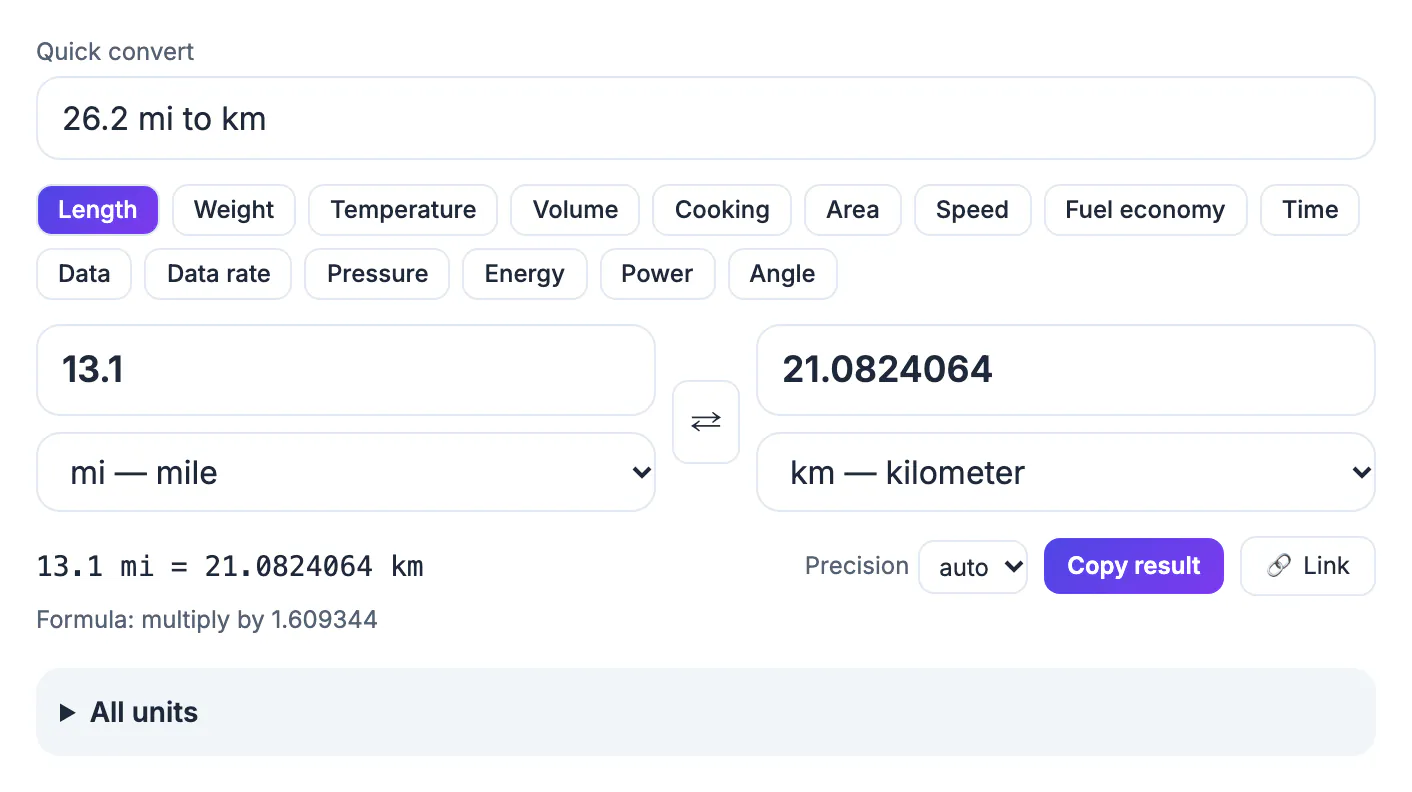
Distances add up. A one percent error in the factor is nothing on a walk to the shop, but over a 26-mile marathon it moves the finish line by almost half a kilometer, and on a 500-mile road trip by five miles' worth of fuel. Using 1.6 as a stand-in is fine for a quick guess, but a race pace, a rental car limit or a fuel plan should use the exact 1.609344.
The miles to km formula
Use kilometers = miles × 1.609344. The reverse is miles = kilometers × 0.621371, or kilometers ÷ 1.609344. The mile is defined as exactly 1,609.344 meters, so the factor is exact.
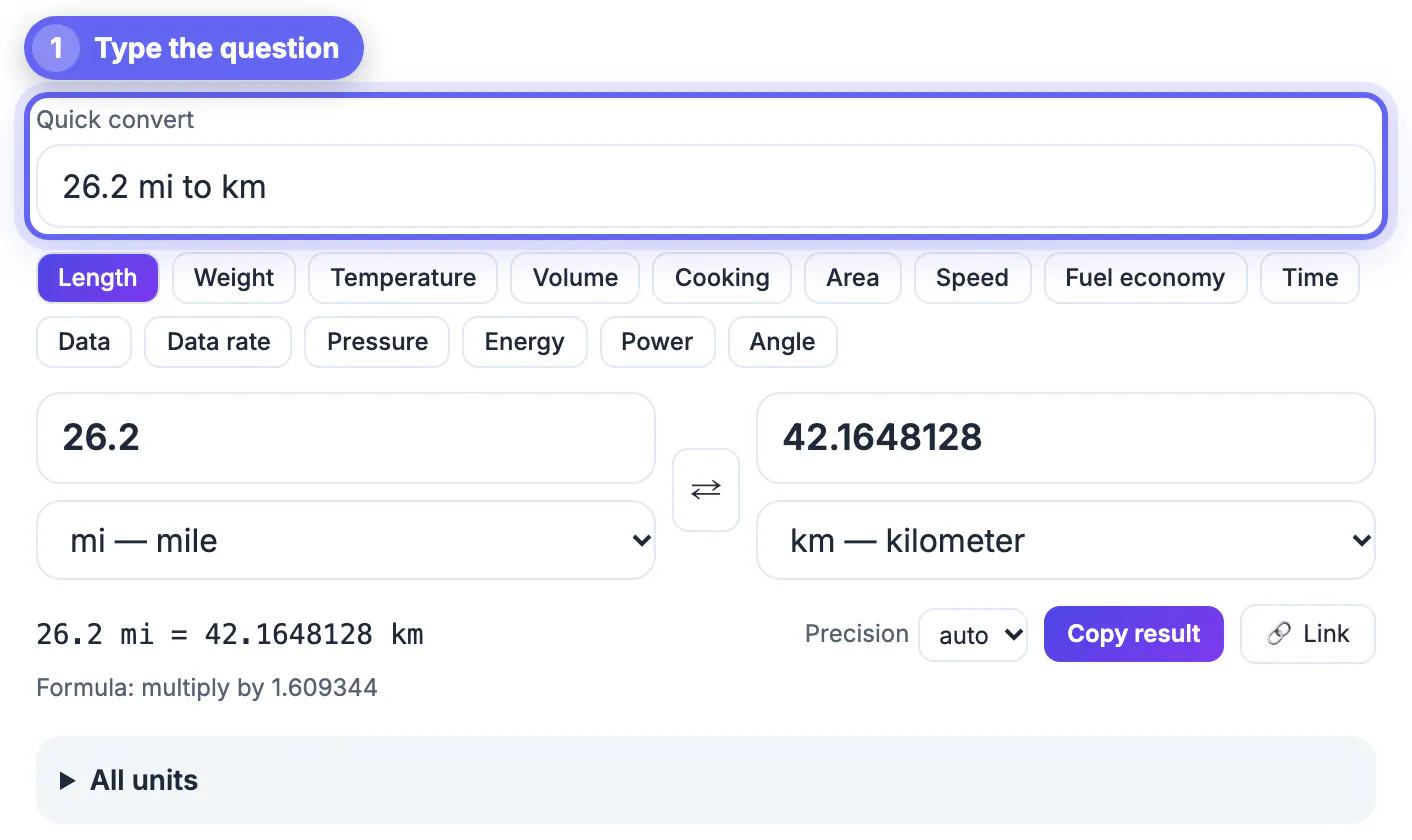
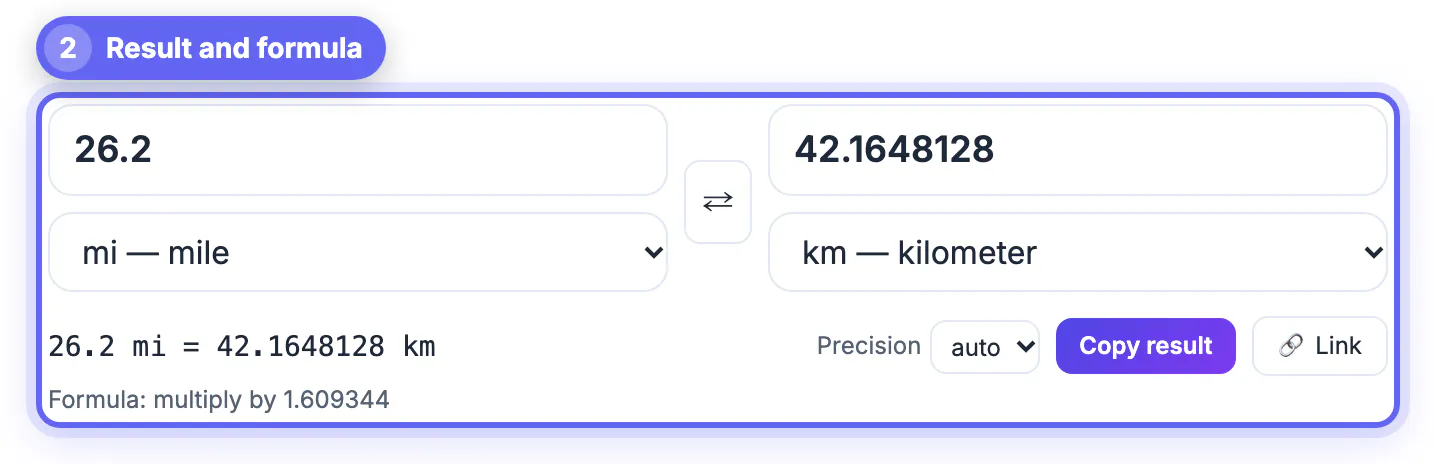
Example: 26.2 mi × 1.609344 = 42.1648 km, which the converter shows as 42.1648128 km. Round to 42.16 km or 42.2 km for everyday use.
Two mental shortcuts
Multiply by 1.6: 10 mi × 1.6 = 16 km, close to the true 16.09. The error is about 0.6 percent, fine for road signs and small runs.
The second shortcut uses the Fibonacci sequence, 1, 2, 3, 5, 8, 13, 21, 34. Because the ratio of neighbors is close to 1.618, a value in miles that is a Fibonacci number is almost its neighbor in kilometers: 5 mi is about 8 km (8.05), 8 mi about 13 km (12.87) and 13 mi about 21 km (20.92). It does not work for arbitrary numbers, but it is a fun way to sanity-check.
Distances people look up
Computed with the exact factor:
- 1 mi = 1.61 km
- 3.1 mi = 4.99 km (a 5K race, roughly)
- 6.2 mi = 9.98 km (a 10K race, roughly)
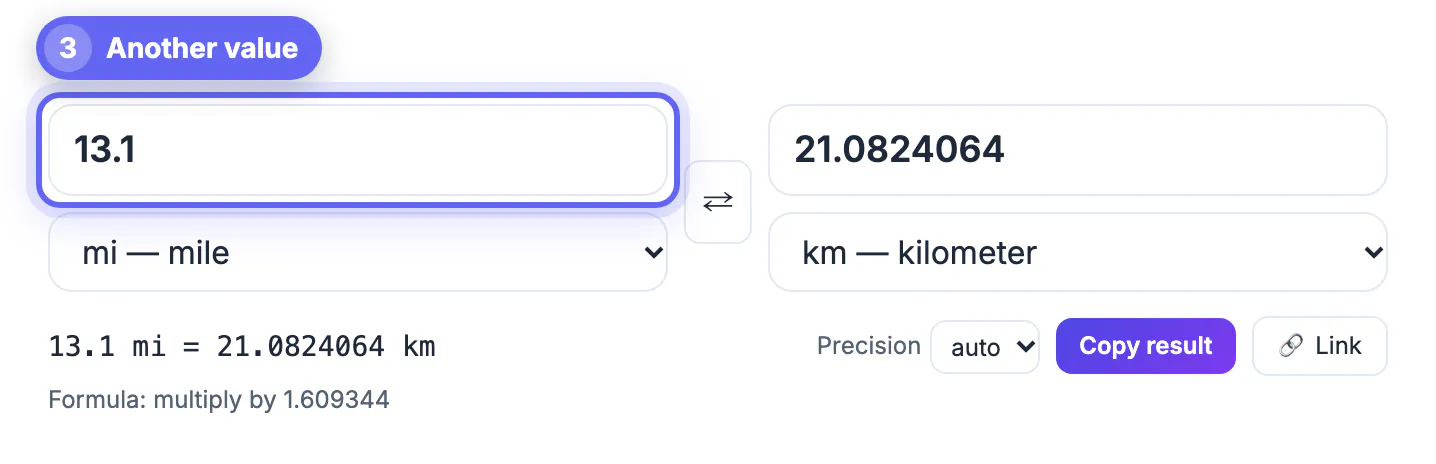
- 13.1 mi = 21.08 km (a half marathon)
- 26.2 mi = 42.16 km (a marathon)
- 60 mi = 96.56 km
- 100 mi = 160.93 km
- 250 mi = 402.34 km
Race distances in miles are rounded, so the 3.1 mi row is 4.99 km rather than exactly 5 km. Race organizers measure the official course in meters.
Speeds and fuel: mph and km/h
The same factor converts speeds. 60 mph is 60 × 1.609344 = 96.56 km/h, and a 70 mph limit is 112.65 km/h. Going the other way, 100 km/h is 62.14 mph. Fuel economy is different: miles per gallon does not convert with the plain distance factor because gallons also change (a US gallon is 3.785 L; an imperial gallon is 4.546 L), so use the converter's Fuel economy tab for that.
Pace works the same way: a 10-minute mile is about 6:13 per kilometer, because 10 ÷ 1.609344 = 6.21 minutes.
Planning a trip in kilometers
When a rental car or a map app is set to kilometers, convert the legs of the trip separately and add the kilometers, not the miles. A route of 120 mi, 85 mi and 45 mi is 193.12 + 136.79 + 72.42 = 402.34 km, which matches converting the 250-mile total once (402.34 km). Fuel stops are easier to plan when every number uses the same system: if your car does about 500 km on a tank, that is 310 miles, so a 250-mile day leaves a comfortable reserve.
Distances on signs abroad are in kilometers, and speed limits are in km/h, so a 50 sign in a town is roughly 31 mph and a 130 sign on a motorway is about 81 mph.
Keeping distances consistent on a trip or a training plan
Choose one system for the whole plan and switch everything to it at the start. Runners following a plan written in miles but racing in kilometers, for example, should rework each target pace and each long-run distance once and write both versions on the schedule, so that they never have to do arithmetic while tired. Drivers crossing a border should switch the car's display and the navigation app to the local setting, and remember that speed limit signs change meaning at the same moment.
Whenever a distance matters for safety, such as fuel range in a remote area, use the exact factor and leave a margin, rather than relying on a rounded mental shortcut.
Pace and running splits
Runners often need to rewrite a plan. A 10 minute per mile pace equals 6:13 per kilometre, because 10 divided by 1.609344 is 6.21 minutes. An 8:00 mile pace is 4:58 per kilometre. When a race is marked in kilometres but your watch records miles, set the watch to km before the start so splits match the signs.
- 5K = 3.11 miles; 10K = 6.21 miles; half marathon = 13.11 miles.
- To estimate quickly, multiply miles by 1.6 and kilometres by 0.62.
- Treadmills display speeds either way; check the setting.
- Training logs: choose one system to avoid mixing totals.
For other measures, general measurement rules offers general rules, and feet to meters handles heights and elevation.
Driving abroad
Road signs in the UK use miles, while most of Europe uses kilometres. Check which system the dial and the signs follow, and keep to the posted limit. Fuel prices are per litre, while distances on a rental agreement may be capped in either unit, so read the contract.
Practical checks before you rely on a figure
Whenever a number comes from a sign, an app or a race website, take a moment to confirm what it describes. Ask whether it is a route length, a straight line or a lap, whether it is rounded, and who measured it. Mixed sources are a frequent cause of mismatches: a bike computer may log one total, a phone another, and an event organiser a third. Writing both versions next to each other, with the date and the source, makes it easy to compare progress later and avoids arguments about who ran or drove further.
For anything involving fuel, tyres or service intervals, follow the figures published by the manufacturer and not a rounded estimate.
Common distance slips to avoid
Treating 5 as a marathon fraction, mixing a 5K with a 5 mile run, or quoting a half marathon as 13 km are frequent errors in race reports and training logs. A quick glance at the ratio helps: the km figure is always larger than the mile figure by about three fifths. Writing the abbreviation after every number stops the mix-up before it starts.
Step-by-step
Common mistakes to avoid
Pro tips
Frequently asked questions
How many kilometers are in a mile?
One mile is exactly 1.609344 kilometers.
How many km is a marathon?
A marathon is 26.2 miles, which is 42.16 km (42.195 km officially).
How do I convert mph to km/h?
Multiply by 1.609344. 60 mph is 96.56 km/h.
Is there an easy trick for miles to km?
Multiply by 1.6, or use the Fibonacci trick: 5 miles is about 8 km, 8 miles about 13 km.
Is a nautical mile the same as a mile?
No. A nautical mile is 1.852 km, about 15 percent longer than a statute mile.
Miles to kilometers is a multiplication by 1.609344. Use 1.6 or the Fibonacci trick for a quick guess, the exact factor for races, fuel and plans, and the converter to see the whole chain of units.
Related guides
Browse more: all calculator guides · Unit Converter