Write a Cold Email With AI That Earns a Reply
To write a cold email with AI, research one specific reason you are contacting this person, give the AI that detail plus your offer and a small ask, and request a message of about 50 to 125 words. Then rewrite the first line yourself so it could only have been sent to them. AI is excellent at the structure and at trimming a rambling pitch; it cannot do the research that makes a stranger reply. A cold email is a message to someone who does not know you: a potential client, a hiring manager for a role that was never posted, a podcast host, a possible mentor. Most get deleted in seconds because they are long, generic and all about the sender. This guide covers the anatomy of a cold email that works, prompts for drafting and personalizing with the free GrabCast AI Writer, follow-up timing, and the US and EU rules to know before you send at any volume.
✍️ Try the AI Writer tool now — freeOpen →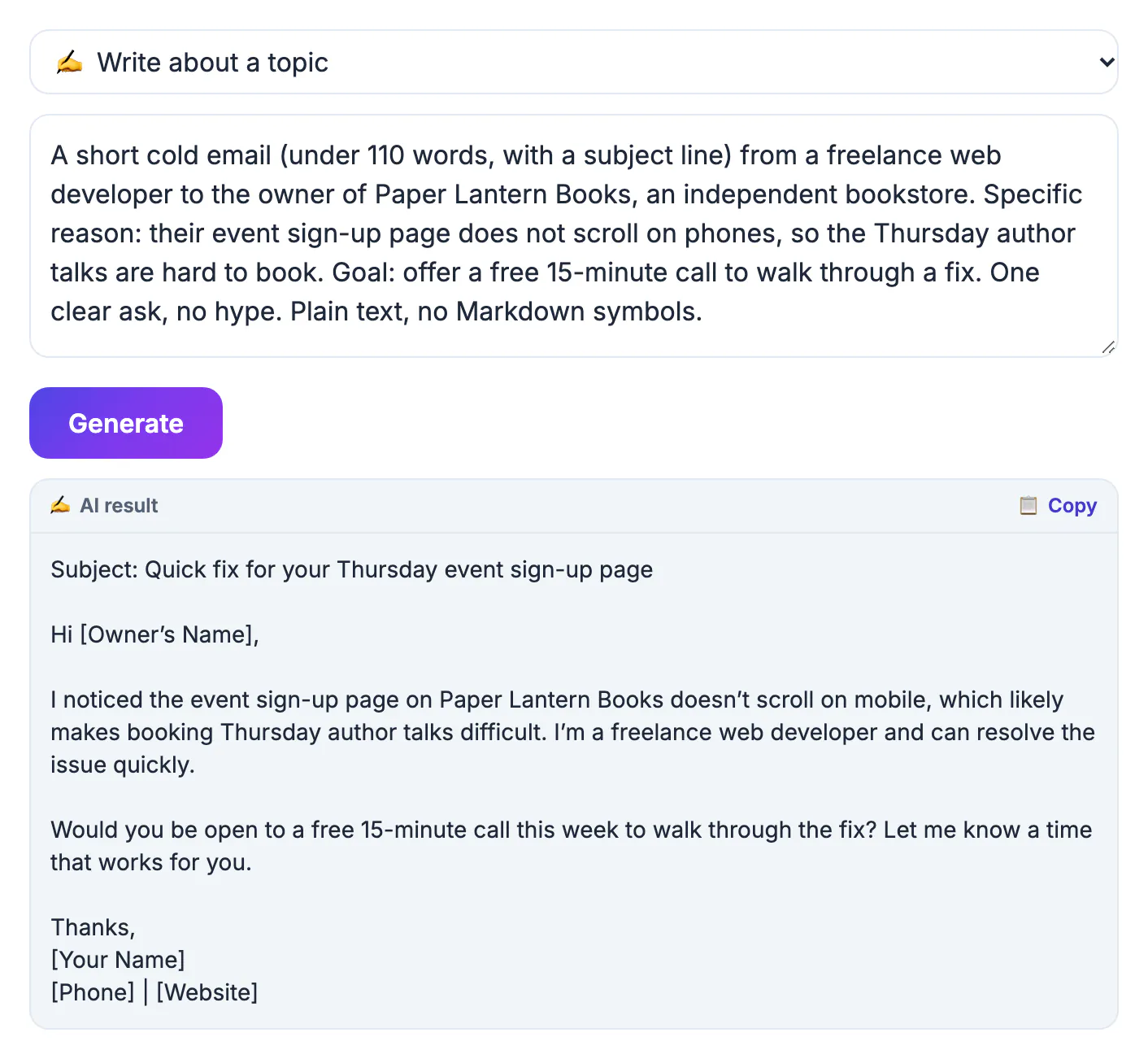
Recipients decide in the preview pane. If the subject and first line could apply to a thousand people, the email is gone before the pitch appears. The irony of AI is that it made generic outreach nearly free, so inboxes are fuller than ever of smooth, forgettable messages, and spam filters have become stricter to match. That raises the value of the one thing AI cannot fake cheaply: a specific, accurate reason for writing to this person today. Use the tool for what it does well, which is tightening your offer into one sentence, cutting length, trying three subject lines and adjusting tone, and spend your own time on ten minutes of research per recipient. A small number of researched emails will usually outperform a large batch of templated ones, and it keeps your domain's sending reputation intact.
Research first: the line AI cannot write
Before you open any AI tool, find one fact that connects you to this reader. A recent post, a product launch, a talk, a job listing, a problem visible on their website. Write it down in one sentence; it becomes the opener.
- Good: I read your post on cutting onboarding time from two weeks to four days, and one step stood out.
- Weak: I came across your company and was impressed by your work.
- Confirm the person actually owns the decision and check the spelling of their name and company.
- Check their LinkedIn or team page for how they write, then match that level of formality.
The anatomy of a cold email that gets answered
An often-cited Boomerang analysis of millions of emails found messages of 50 to 125 words got the best response rates. Five short parts fit comfortably in that range.
- Subject line: three to seven specific words, such as Question about your onboarding checklist. No fake RE: or urgency tricks.
- Opener: the researched line, about them, not you.
- Value: one sentence on the specific problem you can help with, with a number if you have one, such as cut support tickets by 30% for a similar team.
- Ask: small and easy, such as worth a 15-minute call next week?, rather than a demo request or a long form.
- Signature: your name, role and one link so they can check you out in five seconds.
Draft a cold email with AI, then personalize it
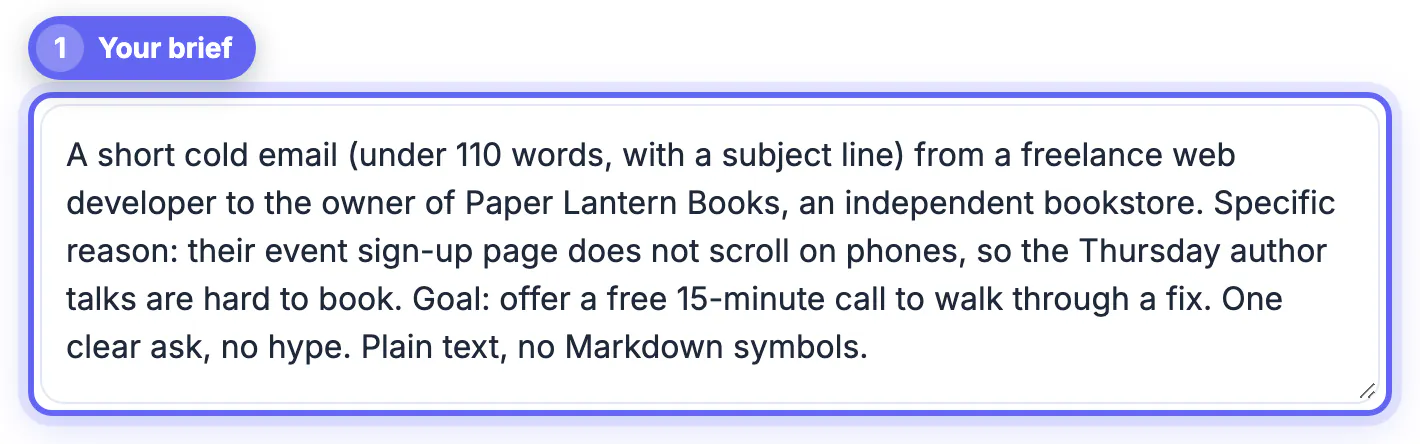
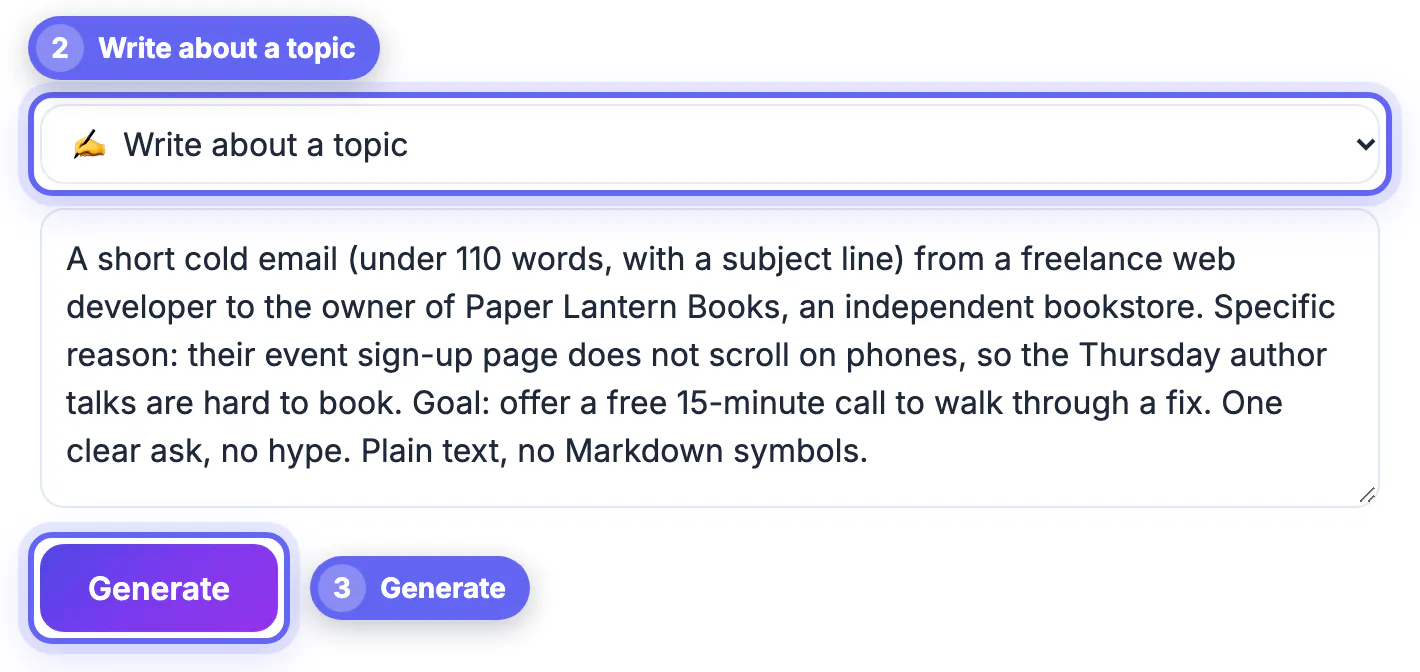
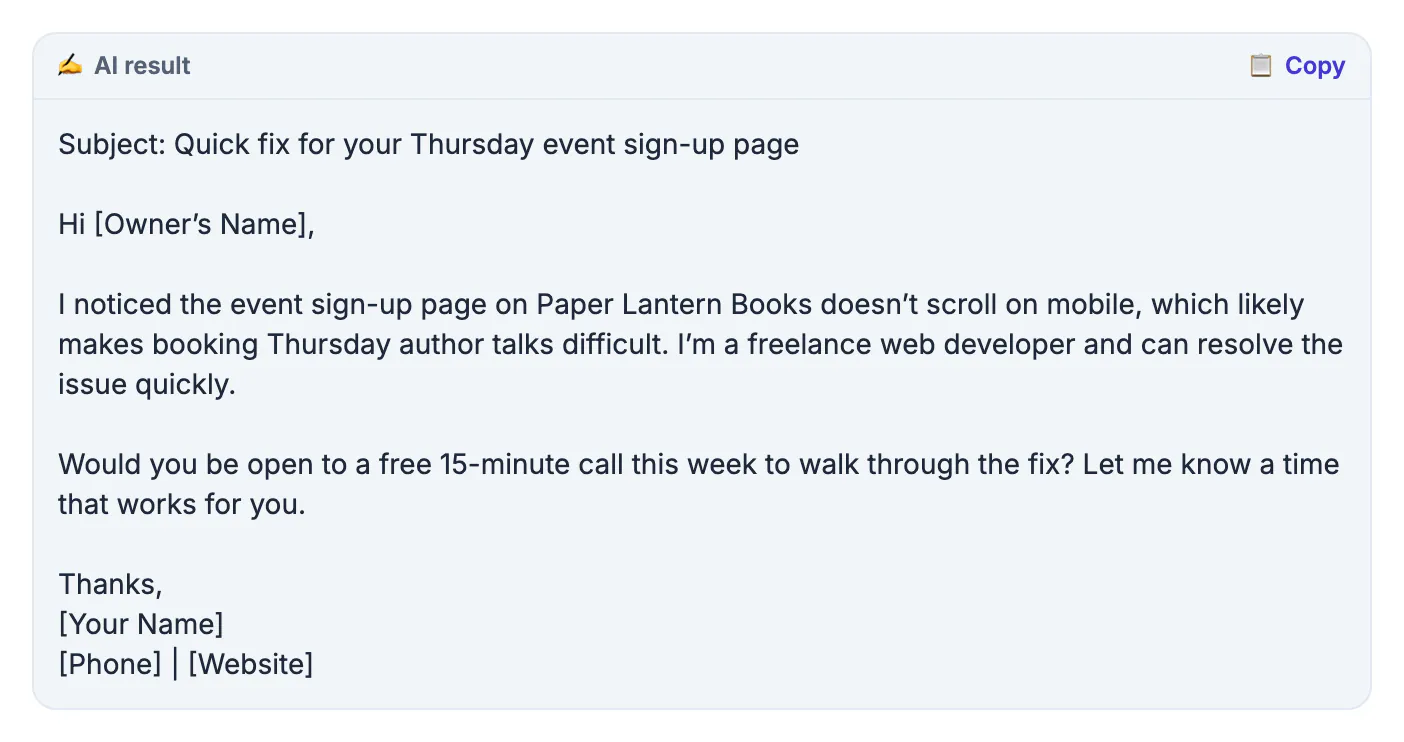
Open the AI Writer, choose Write a reply / email and give it the recipient, your research line, your offer and the ask. A prompt that works: Write a cold email under 110 words to [role] at [company]. Open with this detail: [research]. Offer: [one sentence]. Ask for [small ask]. Plain, friendly, no hype.
- Ask for three subject lines and pick the most specific, not the cleverest.
- If the draft opens with I hope this finds you well or I am reaching out, delete it and start with your research line.
- Cut adjectives such as innovative and cutting-edge; replace them with one concrete result.
- The free service allows about 300 requests a day per IP address, but the real limit should be how many people you can research properly.
Follow up, stay legal and protect deliverability
Many replies come from a follow-up, so plan one or two. Wait three or four business days, then about a week, and add something new each time, such as a relevant example or a short resource, instead of just bumping the thread. Stop after two or three touches.
- US: the CAN-SPAM Act applies to commercial email, including business-to-business. Use honest headers and subject lines, include a physical postal address and a clear way to opt out, and honor opt-outs within 10 business days.
- EU and UK: rules on unsolicited business email vary by country, and some, such as Germany, generally require prior consent. Check local rules and GDPR before emailing EU contacts; this is not legal advice.
- Since 2024, Gmail and Yahoo require bulk senders to authenticate their domain with SPF, DKIM and DMARC and to keep spam complaints low. Send cold outreach in small, personal volumes.
- Never buy email lists; bounces and complaints from purchased lists damage your domain for all your mail.
Deliverability starts with your domain, and the Email DNS Checker reads its SPF, DKIM and DMARC records. Tag links with the UTM Builder to see which emails get clicks.
Step-by-step
Common mistakes to avoid
Pro tips
Frequently asked questions
Do cold emails still work?
Yes, when they are short, researched and relevant. Mass-produced outreach performs worse than ever because filters and readers spot it quickly, but a specific email to the right person still gets answered.
How long should a cold email be?
Aim for about 50 to 125 words, the range an often-cited Boomerang analysis linked to the best response rates. That is enough for a researched opener, one value line and a small ask.
How do I personalize cold emails at scale with AI?
Research each recipient yourself and feed the AI that one detail per email. AI can adapt structure and tone quickly, but inventing personal details it cannot verify looks fake and damages trust.
How many follow-ups should I send?
One or two, spaced three or four business days and then about a week apart. Each should add something new. After two or three unanswered touches, stop.
Is the GrabCast AI Writer free for cold outreach?
Yes, with no signup, at about 12 requests a minute and 300 a day per IP address. It drafts text only; it does not send email, and your prompt is processed by a cloud AI provider.
A cold email written with AI gets replies when the research is yours and the structure is the AI's. Find one specific reason to contact each person, ask for 50 to 125 words with a small ask, rewrite the opener yourself, and follow up once or twice with something new. Stay within CAN-SPAM and local EU rules, keep volumes personal, and your outreach will read like a message from a person, because it is.
Related guides
Browse more: all AI guides · the AI Writer tool