Write Product Descriptions With AI: Specs to Sales Copy
To write product descriptions with AI, give the tool a short fact sheet for one product (specs, materials, the buyer and the main reason to choose it) and ask for a benefit-led opening line, a short paragraph and a few scannable bullets. Then check every claim against the real product before it goes live. The GrabCast AI Writer does the drafting free in your browser with no account, so you can work through a catalog one item at a time. Online shoppers cannot touch or try what you sell, which means the description has to answer the questions a store clerk would: what is it for, will it fit, how long will it last, and why this one. AI is fast at turning dry specs into that kind of answer, but it will also happily invent a feature or a claim you cannot prove. This guide shows the workflow, a worked example and the rules that keep your copy honest.
🏷️ Try the AI Writer tool now — freeOpen →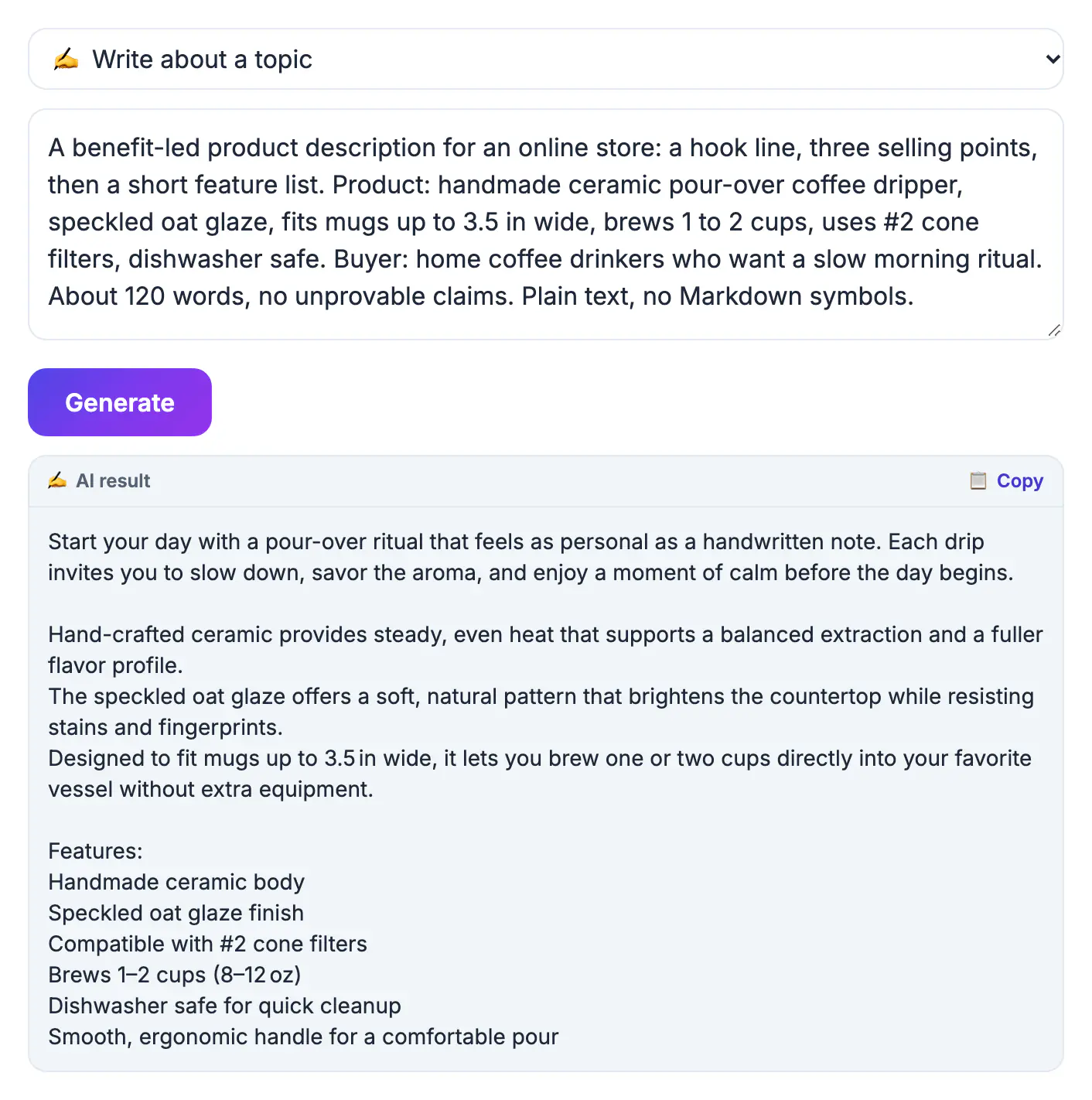
Store owners rarely struggle with the first description. They struggle with the fortieth, when every sentence starts to sound like the last and the copy slides back into manufacturer boilerplate. AI keeps the voice consistent across a catalog and is good at the translation step: turning a feature into what it means for the buyer. That helps conversions, and unique descriptions also help search, since pages that reuse the manufacturer's text compete with every other store using the same words. The danger is invention. Models fill gaps with plausible details, such as a waterproof rating the product does not have or a lifetime warranty nobody offers. Every one of those is a potential return, a bad review or, in the US and EU, a misleading advertising problem. Use AI for the wording, never for the facts.
Build a fact sheet before you prompt
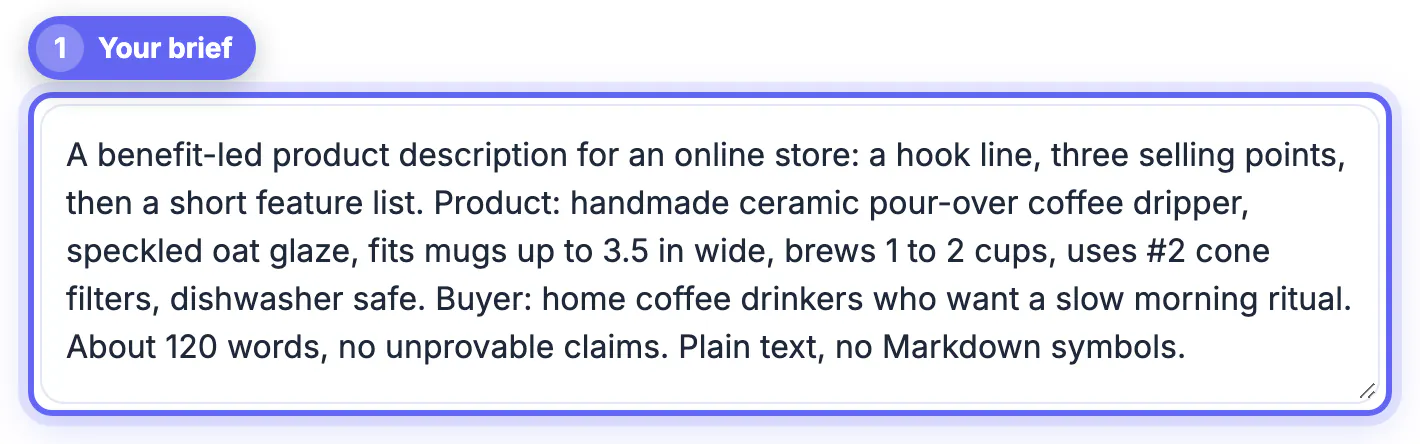
Generic input produces generic copy. Before you open the Write about a topic mode, write five or six lines of verified facts. This is the only information the AI should use, and you should say so in the prompt: use only these facts and do not add features.
- Specs you can prove: size, weight, materials, capacity, compatibility, what is in the box.
- The buyer: for example, commuters who cycle to work, or parents packing school lunches.
- The main reason to choose it over the ten similar products a shopper is comparing.
- Tone and length: playful or premium, and a target such as 120 words plus five bullets.
- Search terms shoppers use, such as the product type and key attributes, so they appear naturally.
Turn features into benefits: a worked example
A feature is what the product has; a benefit is what it does for the buyer. Take a 24 oz stainless steel bottle with double-wall vacuum insulation, which the manufacturer tested to keep drinks cold for 24 hours, and a leak-proof lid. The spec line double-wall vacuum insulated, 24 oz becomes ice still rattling at the end of a full workday, with enough water to skip the refill line. Ask the AI to do this translation for every feature, then keep the specs underneath as proof.
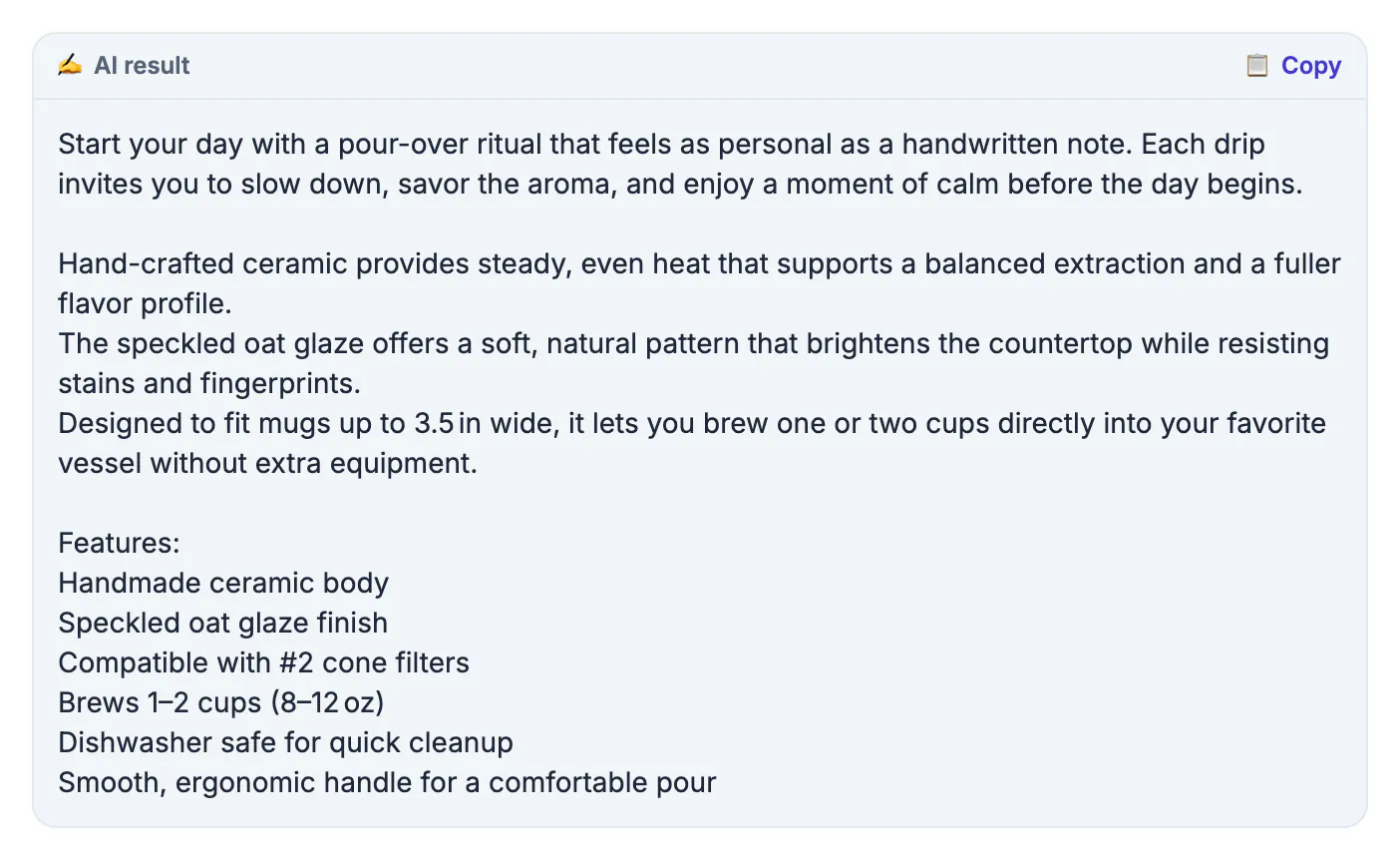
- Opening line: the single biggest payoff, written for the buyer you named.
- Short paragraph: two or three sentences on how it fits into their day.
- Bullets: one benefit per line, each ending with the spec that proves it.
- A battery example of the same move: 3,000 mAh is a feature; lasts two full days on a charge is the benefit, if your testing supports it.
Check every claim before it goes live
In the US, the FTC requires advertising claims to be truthful and backed by evidence, and product pages count. In the EU, the Unfair Commercial Practices Directive covers misleading claims, and new rules applying from September 2026 restrict vague environmental claims such as eco-friendly unless you can prove them. You do not need a lawyer for every listing, but you do need to delete anything you cannot support.
- Remove superlatives like best, strongest or longest-lasting unless you have a test or source.
- Made in USA claims must meet the FTC standard of all or virtually all made in the US.
- Green claims such as biodegradable or carbon neutral need specific, documented proof.
- Health, safety and waterproof ratings must match the product's actual certification.
Scale product descriptions with AI without cloning them
A catalog of 200 products is where AI saves the most time, and where the laziest approach fails. Filling one template with swapped product names gives you near-identical pages that neither shoppers nor search engines value. Work one product per request so each description reflects that item's real differences.
- Keep a style note, covering voice, banned words and bullet format, and paste it into every request.
- Draft a batch of ten, edit them, then compare them side by side for repeated phrases.
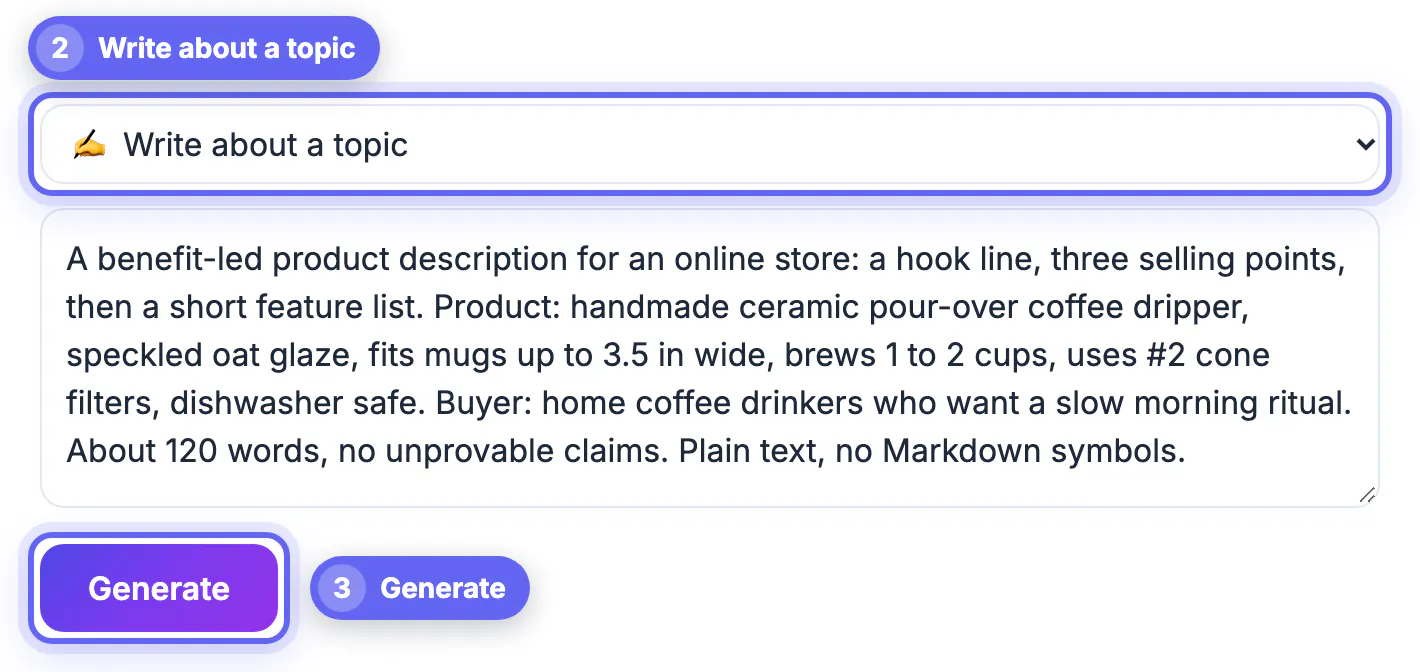
- The free AI Writer allows about 300 requests a day per IP, which comfortably covers a working day of catalog edits.
- Selling into Europe? Translate the approved English copy with an AI translator, then have a native speaker check the key claims.
Product photos need words too; the AI Alt Text Generator can draft a first description for each image.
Step-by-step
Common mistakes to avoid
Pro tips
Frequently asked questions
Will AI-written product descriptions hurt my SEO?
Not if they are accurate, unique and useful. Problems come from copied manufacturer text or near-identical templated pages, not from using AI to draft. Edit each description to reflect that product's real differences.
Can AI match my brand voice?
Reasonably well if you show it. Paste two of your best existing descriptions with a short style note, such as playful, second person, no exclamation marks, and ask it to follow that pattern.
How do I stop AI from inventing product details?
Give it a fact sheet and tell it to use only those facts. Then compare the draft with the sheet and delete anything new. Never publish a spec, rating or warranty you have not verified.
How long should a product description be?
Long enough to answer buying questions. For many products that is a benefit-led line, 50 to 150 words of copy and a few bullets; complex or expensive items can need more.
Is the AI Writer free for store owners?
Yes, with no signup. It allows about 12 requests a minute and 300 a day per IP address. Your text is sent to a cloud AI provider, so keep supplier pricing and unreleased products out of it.
Writing product descriptions with AI works when the facts come from you and only the wording comes from the model. Build a short fact sheet, ask for benefit-led copy with specs as proof, delete anything invented or unprovable, and work one product at a time so every page is genuinely different. That gives you catalog-scale speed without the returns, reviews and legal risk that follow a made-up claim.
Related guides
Browse more: all AI guides · the AI Writer tool